


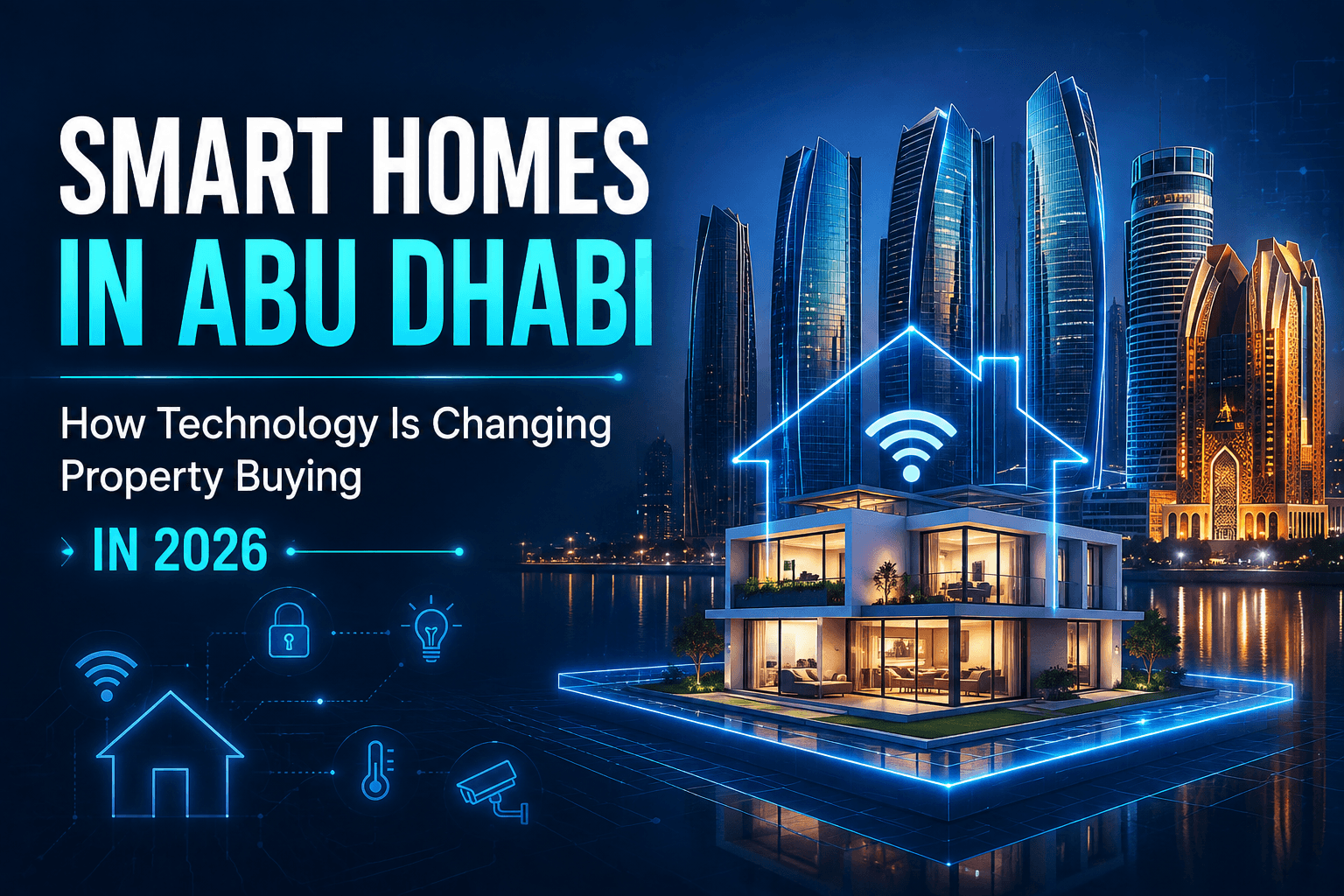
Technology is transforming the way people live, work and choose their homes. The growing popularity of smart homes in Abu Dhabi is becoming an important trend in the city's real estate market, with buyers increasingly looking beyond location, size and design when choosing a property.
Modern homeowners are now considering features such as automated lighting, smart security, intelligent climate control, connected appliances and remote property management as part of the overall value of a home.
For property buyers and investors, understanding this change can be important. Smart-home technology can improve convenience, security and energy management while potentially making a property more attractive to future tenants and buyers. As Abu Dhabi's real estate market continues to evolve, technology is becoming another factor worth considering alongside price, location and long-term investment potential.
What Is a Smart Home?
A smart home is a property where different systems, appliances and devices are connected through technology and can be monitored or controlled digitally.
Depending on the property, smart-home systems can include:
- Smart lighting
- Automated curtains and blinds
- Smart air-conditioning controls
- Smart door locks
- Video doorbells
- Security cameras
- Motion sensors
- Smart appliances
- Energy monitoring systems
- Voice-controlled devices
- Home entertainment systems
- Automated irrigation
Instead of controlling every system manually, residents can use a smartphone, tablet, voice assistant or central control system to manage different parts of their home.
In Abu Dhabi, smart-home technology can range from simple connected devices to fully integrated systems that are incorporated into a property's design and infrastructure.
This distinction is important because a property marketed as a "smart home" may offer only a few connected devices, while a fully integrated smart property can provide automation across multiple areas of everyday life.
Why Are Smart Homes Becoming More Popular in Abu Dhabi?
The growing interest in smart homes in Abu Dhabi in 2026 reflects changing expectations among modern property buyers and tenants.
Convenience, security, energy management and remote access are becoming increasingly important features for people choosing where to live.
For families, smart security systems and automated climate control can provide additional convenience. For busy professionals, remote control of household systems can make everyday life easier. For investors and landlords, smart locks, remote monitoring and automated systems can make certain aspects of property management more convenient.
The trend is also connected to the broader development of modern residential communities. As new properties incorporate advanced infrastructure and technology, buyers may increasingly expect homes to offer more than traditional amenities.
Smart Home Features Buyers Should Look For
Not all smart-home systems offer the same level of functionality. Buyers should look beyond terms such as "smart," "connected" or "automated" and understand exactly what technology is included.
1. Smart Lighting
Smart lighting is one of the most common smart home features available today.
Connected lighting systems allow residents to control lights through mobile applications, switches, sensors or automated schedules.
Some systems can automatically switch lights on when someone enters a room and turn them off when the room is empty. Others allow homeowners to create different lighting settings for different times of the day.
For buyers, the important question is whether the lighting system is professionally integrated into the property or simply consists of replaceable smart bulbs and switches.
2. Smart Climate Control
Climate control is particularly important in Abu Dhabi because air conditioning plays a major role in everyday life.
Smart thermostats and connected air-conditioning systems can allow homeowners to adjust temperature settings remotely and create schedules based on their daily routines.
For example, residents may be able to adjust the temperature before arriving home or reduce cooling when the property is empty.
Buyers should check whether smart climate technology is integrated into the property's main air-conditioning system or simply provides remote control of an existing system.
3. Smart Security
Security is another important application of smart-home technology.
Depending on the property, systems may include:
- Smart locks
- Video doorbells
- Security cameras
- Motion sensors
- Door and window sensors
- Remote access notifications
- Integrated alarm systems
These features can give homeowners greater visibility and control over their property.
Smart security can also be useful for investors who live outside Abu Dhabi or manage properties remotely. However, buyers should understand how the systems are maintained and what happens if a device or connection stops working.
4. Smart Appliances
Connected appliances are another growing part of modern residential technology.
These may include:
- Smart refrigerators
- Washing machines
- Ovens
- Dishwashers
- Robot vacuum cleaners
- Coffee machines
Smart appliances can provide additional convenience, but buyers should not automatically assume that every connected appliance adds significant property value.
It is more important to consider the quality of the appliance, warranty, replacement costs, availability of technical support and whether the technology genuinely improves the living experience.
5. Automated Curtains and Blinds
Automated curtains and blinds can be programmed according to time, sunlight or user preferences.
For example, curtains may automatically open in the morning and close in the evening.
In Abu Dhabi's climate, automated window coverings can also contribute to indoor comfort by helping residents manage sunlight and heat entering the property.
6. Smart Energy Monitoring
Energy-monitoring systems can help homeowners understand how much electricity different systems and appliances are using.
Instead of relying only on a monthly utility bill, residents may be able to monitor consumption in greater detail.
This can help identify unnecessary energy use and encourage more efficient household habits.
For buyers who are interested in sustainability and long-term operating costs, energy monitoring may become an increasingly attractive property feature.
How Technology Is Changing Property Buying in Abu Dhabi
Technology is changing the questions buyers ask when viewing a property.
Traditionally, buyers have focused on factors such as:
- Location
- Property size
- Number of bedrooms
- Parking
- Building amenities
- Views
- Price
Today, buyers may also ask:
- Is the property smart-home enabled?
- Which systems are automated?
- Can the technology be controlled remotely?
- Is there a central control system?
- Which devices are included?
- Who maintains the system?
- Are there additional maintenance costs?
- What happens if the technology becomes outdated?
This means Abu Dhabi property technology is becoming part of the wider property evaluation process.
However, smart features should always be considered alongside traditional property fundamentals such as location, construction quality, service charges, market price and rental demand.
For a broader understanding of property pricing, buyers can also explore our Buying Property in Abu Dhabi: 10 Mistakes to Avoid
Do Smart Homes Have Higher Property Value?
One of the biggest questions for buyers and investors is whether smart technology increases property value.
The answer depends on several factors.
A few inexpensive smart devices may have little impact on the long-term value of a property. A professionally integrated smart-home system, however, may make a property more attractive to certain buyers and tenants.
The impact can be stronger when technology is combined with other desirable property features such as:
- Prime location
- High-quality construction
- Modern interiors
- Strong community amenities
- Good security
- Energy-efficient systems
- Attractive views
- Convenient access to important destinations
Therefore, buyers should not assume that a property is automatically a better investment simply because it is marketed as a smart home.
The underlying property fundamentals remain extremely important.
Investors considering a purchase should evaluate smart technology alongside price, rental demand, expected costs and potential returns. Our How to Increase ROI from Your Property in Abu Dhabi | Expert Strategies? provides additional information for investors evaluating the market.
Smart Homes and Rental Demand
Smart technology may also influence tenant preferences.
Young professionals, international residents and technology-oriented households may appreciate features that make daily life easier.
For landlords, smart technology can provide another way to differentiate a property from competing rental units.
For example, smart locks can simplify controlled access, while remote monitoring systems may help owners manage certain aspects of their property from another location.
However, landlords should consider whether tenants in their target segment actually value these features.
The cost of installing and maintaining technology should also be compared with the potential rental benefit.
Investors interested in rental returns can learn more through our Top 5 Areas for Rental Yield in Abu Dhabi 2026
Are Smart Homes a Good Choice for Property Investors?
Smart homes can provide opportunities for investors, but technology should be viewed as one part of the overall investment strategy.
Location Still Matters
A technologically advanced property in a weak location may not necessarily perform better than a conventional property in a high-demand area.
Location, accessibility, community amenities and rental demand remain fundamental factors.
Understand the Target Tenant
Investors should consider who is likely to rent the property.
A smart-home system may have greater appeal to some tenant groups than others.
Consider the Purchase Premium
If a smart property costs significantly more than comparable properties, investors should assess whether the additional cost can realistically be recovered through rent or future resale.
Check Maintenance Costs
Smart devices can require software updates, replacement parts and technical support.
Investors should understand these potential expenses before purchasing.
Look at Long-Term Compatibility
Technology changes quickly.
A system that is considered advanced today may become outdated in several years. Buyers should therefore consider whether the system can be upgraded or expanded over time.
Smart Homes and Off-Plan Properties
The development of smart-home technology is particularly interesting in Abu Dhabi's off-plan property market.
Developers can integrate technology into a property during the design and construction process instead of adding systems after completion.
This can make it easier to create integrated lighting, climate control, access and security systems.
However, buyers should carefully review the property's official specifications before purchasing.
Promotional material may show a wide range of technology, but buyers should confirm exactly which features are included in the purchase.
Before booking an off-plan smart property, consider checking:
- Smart-home specifications
- Included appliances
- Automation systems
- Security features
- Technology brands, where specified
- Handover specifications
- Warranty terms
- Maintenance arrangements
If you are comparing a ready property with an off-plan purchase, read our guide on Off-Plan vs Ready Property in Abu Dhabi: Which Investment is Better in 2026?
What Should Buyers Check Before Buying a Smart Home?
Before buying a smart home in Abu Dhabi, buyers should inspect both the physical property and its technology.
Check What Is Actually Included
Ask the developer or seller for a complete list of smart features.
Do not rely solely on the phrase "smart home."
Find out exactly what is included in the purchase.
Test the Systems
Where possible, test important features during the viewing or inspection.
Check:
- Lighting
- Air-conditioning controls
- Smart locks
- Security systems
- Curtains
- Appliances
- Central control panels
Understand Ownership
Ask whether the smart devices and systems are included with the property and whether they transfer to the buyer after completion.
Check Compatibility
Some smart-home systems depend on specific applications, hubs or manufacturers.
Buyers should understand whether additional devices can be added later and whether the system can work with other technology.
Ask About Maintenance
Find out who is responsible if the smart system stops working.
This is particularly important for investors who intend to rent out the property.
Review Warranty Terms
Technology can fail just like any other property system.
Buyers should understand warranty coverage and whether replacement or repair costs are included.
Consider Privacy
Connected devices can collect information about how a property is used.
Buyers should understand what data is collected, how it is handled and who may have access to it.
Smart Technology at Property Handover
Smart-home systems should also be checked during property handover.
Buyers should verify that the technology installed in the property matches the specifications agreed during the purchase.
Important items to test can include:
- Smart locks
- Lighting controls
- Climate systems
- Security devices
- Intercoms
- Automated curtains
- Connected appliances
- Central control systems
For a wider checklist covering the property handover process, read our Abu Dhabi Property Handover Guide.
Smart Homes and Sustainability
Smart technology can also support energy efficiency.
Automated lighting, intelligent climate controls and energy-monitoring systems can give residents greater control over electricity consumption.
However, smart technology alone does not make a property sustainable.
Other factors such as building design, insulation, cooling efficiency, materials and energy infrastructure are also important.
The best results may come from combining efficient building design with technology that allows residents to monitor and control how the property operates.
The Future of Smart Homes in Abu Dhabi
The future of smart homes in Abu Dhabi is likely to extend beyond individual apartments and villas.
Technology may increasingly become part of entire residential communities.
Future developments could connect:
- Homes
- Parking
- Security
- Community facilities
- Energy systems
- Transportation
- Building management
- Retail
- Entertainment
This could change the way buyers evaluate new developments.
Instead of simply asking whether an apartment has smart lighting or a smart lock, buyers may eventually consider how connected the entire community is.
This could make technology an increasingly important part of the overall lifestyle offered by a residential development.
As Abu Dhabi's real estate market continues to develop, technology may become a standard expectation in certain segments rather than a premium luxury feature.
For a broader view of where the Abu Dhabi property market is heading, read our How to Buy Property in Abu Dhabi as a Foreigner in 2026 (Complete Guide)
Smart Homes vs Traditional Homes: Which Is Better?
There is no universal answer.
A traditional property may be more suitable for buyers who prefer simplicity, straightforward maintenance and fewer technology-dependent systems.
A smart home may be more attractive to buyers who value:
- Convenience
- Automation
- Security
- Energy monitoring
- Remote access
- Modern lifestyle features
For investors, the decision should be based on rental demand, purchase price, operating costs and potential resale appeal.
The best property is not necessarily the one with the most technology. It is the property where the technology provides genuine value while the underlying real estate fundamentals remain strong.
How to Evaluate a Smart Property Before Buying
A simple way to evaluate a smart property is to consider five areas:
| Factor | What Buyers Should Check |
|---|---|
| Technology | What smart features are actually included? |
| Reliability | Who maintains and supports the systems? |
| Cost | Is there a premium for the technology? |
| Usability | Are the systems simple to operate? |
| Investment Value | Will the features appeal to future buyers or tenants? |
This approach can help buyers avoid paying an unnecessary premium simply because a property is advertised as technologically advanced.
Final Thoughts
The rise of smart homes in Abu Dhabi is an important development in the city's evolving real estate market.
From automated lighting and climate control to smart security, connected appliances and energy monitoring, technology can make properties more convenient, connected and attractive to modern buyers.
For homeowners, smart technology can improve everyday convenience and control. For tenants, it can provide a more modern living experience. For investors, it may offer another way to differentiate a property and appeal to technology-conscious tenants and buyers.
However, technology should never be the only reason to purchase a property.
Location, price, construction quality, developer reputation, community amenities, service charges, rental demand and long-term potential should remain central to the decision.
As technology continues to evolve, buyers who understand both the benefits and limitations of smart-home systems will be better positioned to make informed property decisions.
If you are exploring property opportunities in Abu Dhabi, explore our featured properties for sale and discover properties that match your lifestyle and investment goals.
Frequently Asked Questions About Smart Homes in Abu Dhabi
What is a smart home in Abu Dhabi?
A smart home is a property equipped with connected technology that allows residents to monitor or control systems such as lighting, climate control, security, appliances and access through digital devices or automated systems.
Are smart homes more expensive in Abu Dhabi?
Smart-home properties can have a higher purchase price depending on the technology, property type, developer, location and level of integration. Buyers should compare the overall property value rather than paying a premium solely for technology.
Do smart homes have better investment potential?
Smart features can make a property more attractive to certain tenants and buyers, but investment performance still depends heavily on location, purchase price, rental demand, property quality and overall market conditions.
What smart features should I look for when buying a property?
Useful features can include smart climate control, security systems, smart locks, automated lighting, energy monitoring and integrated home-management systems.
Are smart homes suitable for rental properties?
They can be, particularly when the technology provides useful features such as smart access, security and climate control. Investors should nevertheless consider maintenance costs, tenant preferences and whether the technology can contribute to rental demand.
Should I buy a smart home or a traditional property?
It depends on your priorities. Buyers who value automation, convenience and technology may prefer a smart home, while those who prioritize simplicity and straightforward maintenance may prefer a traditional property.
What should I check before buying a smart home?
Buyers should confirm which smart features are included, test the systems, review warranties, understand maintenance responsibilities, check compatibility and consider privacy and long-term technology support.
Conclusion
Smart-home technology is becoming an increasingly interesting part of Abu Dhabi's residential property market. While technology cannot replace the fundamentals of a good property investment, well-designed smart features can enhance convenience, security, efficiency and overall property appeal.
For buyers and investors, the key is to look beyond the "smart home" label and determine whether the technology provides genuine long-term value.
By combining technology with the right location, property quality, price and investment fundamentals, buyers can make more informed decisions in Abu Dhabi's evolving real estate market.



Join The Discussion