



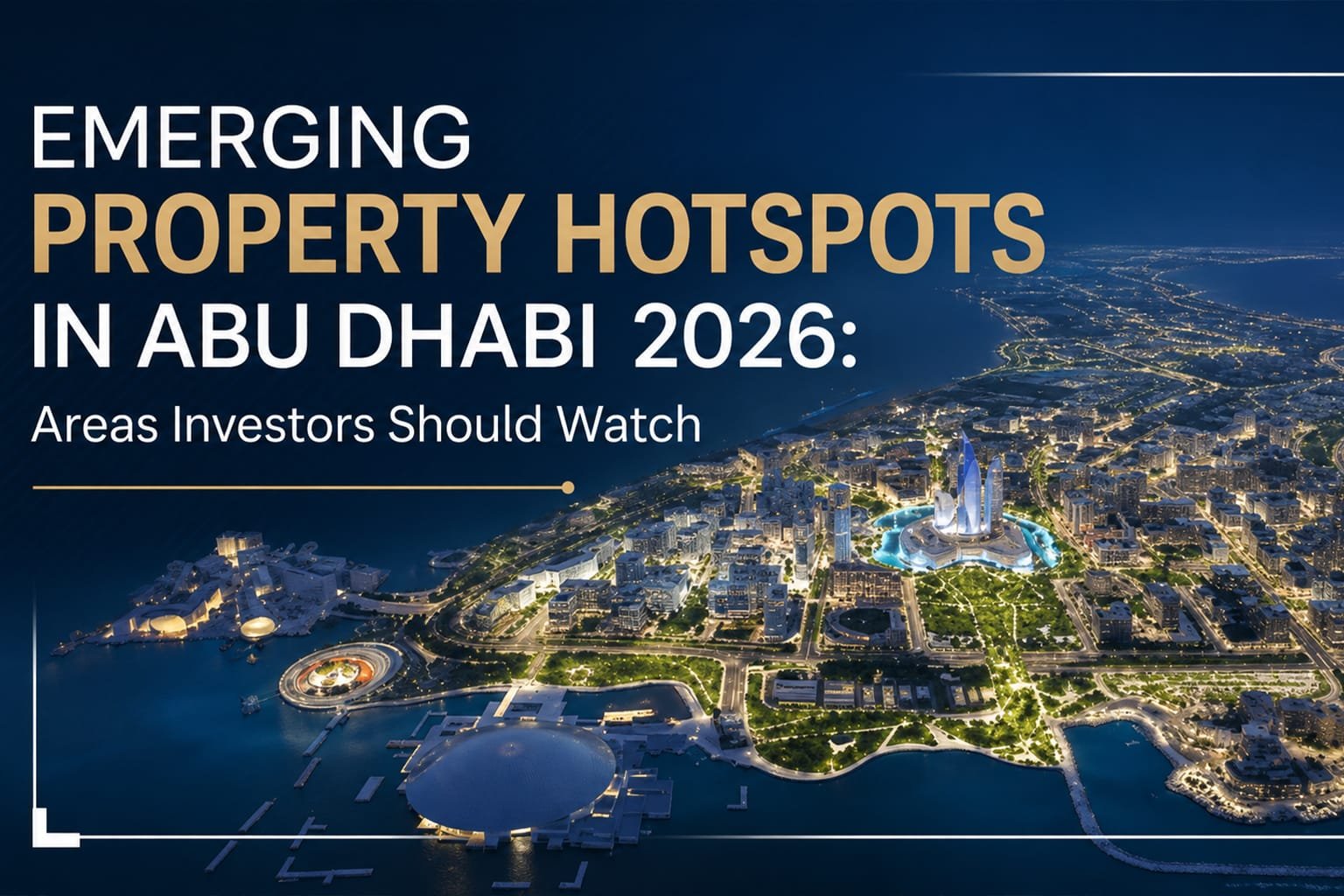
Emerging Property Hotspots in Abu Dhabi 2026: Areas Investors Should Watch
For years, Abu Dhabi Island has been at the centre of the emirate's residential property market. However, investors are increasingly looking beyond the traditional city-centre locations as new communities, master-planned destinations and lifestyle developments continue to expand across the emirate.
The changing investment map is creating opportunities for buyers who are willing to look beyond established neighbourhoods and identify locations with strong infrastructure, growing demand, new development activity and long-term potential.
In 2026, areas such as Hudayriyat Island, Yas Island, Al Reem Island, Al Raha and Jubail are attracting attention for different reasons. Newer destinations are also entering the conversation as Abu Dhabi continues to expand its residential and investment offering.
So, which are the emerging property hotspots in Abu Dhabi, and what should investors consider before buying?
Why Are Investors Looking Beyond Abu Dhabi Island?
Abu Dhabi Island remains an important residential and business centre, but the emirate's property market is no longer concentrated in one location.
The expansion of residential communities outside the main island has given buyers more choices in terms of property type, lifestyle, price point and investment strategy.
New communities can offer larger master plans, waterfront living, modern amenities, villas, townhouses and apartments designed around specific lifestyle concepts.
For investors, this creates an opportunity to look at areas before they become fully established.
Instead of asking only where property is performing well today, investors can also ask where population, infrastructure, amenities and development activity are likely to support future demand.
This is one reason the search for Abu Dhabi property investment areas is becoming more sophisticated.
What Makes an Area an Emerging Property Hotspot?
Not every new development automatically becomes a successful investment location.
Before buying in an emerging area, investors should consider several factors.
Infrastructure and Accessibility
Good roads and convenient connections to employment centres, airports, schools, retail destinations and entertainment attractions can support long-term demand.
New Development Activity
Major residential and mixed-use developments can bring new residents, businesses, retail and community facilities into an area.
Rental Demand
Investors should understand who is likely to rent the property and whether there is sustainable demand for the specific property type.
Lifestyle Appeal
Waterfront access, parks, beaches, entertainment, restaurants, schools and recreational facilities can influence both tenant and buyer preferences.
Supply
An area with too much competing inventory can face pressure on rents and resale values. Investors should therefore consider not only current supply but also the amount of future development planned.
Entry Price
Emerging locations can sometimes provide investors with different entry points compared with Abu Dhabi's most established premium communities.
The key is to compare the price with the property's location, quality, expected demand and long-term potential rather than simply looking for the cheapest property.
1. Hudayriyat Island: A Major Area to Watch
Hudayriyat Island has become one of the most closely watched areas in Abu Dhabi's property market.
Its appeal comes from a combination of waterfront living, large-scale development, leisure facilities and new residential projects.
The area is developing as more than a residential destination. Its wider lifestyle offering is an important part of its appeal, particularly for buyers looking for outdoor recreation, open spaces and modern community facilities.
For investors, Hudayriyat represents a longer-term development story.
The area may appeal particularly to buyers who are comfortable investing in a destination that is still evolving rather than relying only on established rental markets.
ADREC reported Hudayriyat Island as the leading area by transaction value in Abu Dhabi in Q1 2026, highlighting the level of market activity around the destination.
Investors should nevertheless evaluate individual projects carefully because performance can vary considerably between developments.
2. Yas Island: More Than an Entertainment Destination
Yas Island has already established itself as one of Abu Dhabi's best-known lifestyle destinations, but its residential market continues to evolve.
The island combines residential communities with entertainment, hospitality, retail and leisure attractions.
This creates a different investment proposition from traditional city-centre apartments.
For landlords, the combination of residents, professionals, families and visitors can create multiple sources of property demand depending on the location and property type.
Yas Island can therefore suit investors looking for a combination of lifestyle appeal and established infrastructure.
The area also demonstrates why investors should not automatically define a hotspot as an entirely new location.
An established community can continue to offer investment potential when new projects, infrastructure and attractions continue to strengthen its appeal.
3. Al Reem Island: A Strong Apartment Investment Market
Al Reem Island is already an established residential market, but it remains an important area for investors looking beyond Abu Dhabi's main island.
Its proximity to central Abu Dhabi and Al Maryah Island makes it attractive to professionals and residents who want access to business districts while living in a modern waterfront community.
The area has a substantial apartment market, making it particularly relevant to investors interested in rental properties.
Current market data also shows strong price performance in Al Reem Island, reinforcing its position as one of the major residential investment locations in the emirate.
However, investors should avoid treating the entire island as one market.
Different buildings and projects can have different levels of rental demand, service charges, views, amenities, unit layouts and resale liquidity.
For investors comparing potential returns, our Abu Dhabi Real Estate Investment Guide provides useful context on evaluating rental-focused investments.
4. Al Raha: Waterfront Living With Strong Connectivity
Al Raha has become another important residential destination outside Abu Dhabi Island.
Its waterfront setting, proximity to major roads and accessibility to Abu Dhabi International Airport make the area attractive to both residents and investors.
The community offers a mixture of apartments, villas and waterfront properties, giving investors more choice than some apartment-focused districts.
Al Raha is particularly interesting for buyers who want to combine lifestyle appeal with accessibility.
The area also demonstrates how established communities can remain relevant as investment hotspots when they continue to benefit from strong demand and convenient connectivity.
Investors interested in waterfront opportunities can also explore our Abu Dhabi Waterfront Properties
5. Jubail Island: A Different Investment Proposition
Jubail Island offers a different type of residential environment from the high-rise apartment communities found closer to central Abu Dhabi.
The destination focuses more heavily on low-density living, villas, townhouses, nature and waterfront surroundings.
This makes it particularly relevant to buyers looking for privacy and a community-oriented lifestyle.
For investors, the appeal is less about high-density apartment liquidity and more about the long-term demand for high-quality villa and townhouse living.
The limited supply of certain property types can also be an important consideration when comparing premium residential destinations.
However, buyers should carefully assess purchase prices, rental demand and the specific project's stage of development before making an investment decision.
6. Newer Destinations Investors Should Keep on the Radar
Beyond the better-known communities, Abu Dhabi's development pipeline continues to create new locations worth monitoring.
Fahid Island is one example of a newer destination attracting attention as the emirate's residential map expands.
Newer areas can offer investors something that established locations cannot always provide: the opportunity to enter a developing community before its full residential and lifestyle ecosystem is established.
But this opportunity comes with additional uncertainty.
Investors should carefully examine the developer, project specifications, payment plan, construction timeline, expected handover and future competing supply.
For a broader look at where investors are finding opportunities, see our Hidden Real Estate Investment Opportunities in Abu Dhabi: Underrated Locations Worth Investing In
Emerging Area vs Established Area: Which Is Better?
There is no single answer.
An established area can offer:
- Existing rental demand
- Completed infrastructure
- Established communities
- Easier property inspection
- More comparable rental and sales data
- Potentially greater resale liquidity
An emerging area can offer:
- Newer properties
- Modern amenities
- New infrastructure
- Master-planned communities
- Potential early-entry opportunities
- New lifestyle concepts
The right choice depends on the investor's objectives.
An investor focused on immediate rental income may prefer an established community with proven tenant demand.
An investor focused on longer-term capital growth may be more comfortable considering an emerging destination.
What Should Investors Check Before Buying in an Emerging Area?
Buying early does not automatically mean buying well.
Investors should carry out detailed due diligence before committing capital.
Research the Developer
Look at the developer's track record, previous projects, delivery history and reputation.
Study the Location
Consider access to major roads, employment centres, schools, hospitals, shopping, entertainment and airports.
Understand the Master Plan
An emerging area can look very different once the full master plan is completed.
Review what is planned for the surrounding community, not just the individual building or villa project.
Check Future Supply
Find out how many additional properties are expected to enter the market.
A popular location can still experience rental pressure if a large amount of competing inventory is delivered at the same time.
Compare Property Prices
Do not compare properties only by total purchase price.
Consider price per square metre, property size, views, amenities, floor level, layout and expected rental income.
Our How to Increase ROI from Your Property in Abu Dhabi | Expert Strategies? can help buyers understand the broader pricing picture.
Evaluate Rental Demand
Ask who will rent the property.
A villa, family townhouse and studio apartment can attract completely different tenant groups.
Consider Exit Strategy
Before purchasing, investors should ask how they plan to exit.
Will the property be sold after completion? Held for rental income? Used as a long-term family asset?
The answer can influence which location and property type makes the most sense.
Why Infrastructure Matters for Property Investment
Infrastructure is one of the most important factors behind the development of new property hotspots.
When an area gains better roads, retail, schools, leisure attractions and community facilities, it can become more convenient for residents.
Convenience can support demand.
This is why investors should look beyond today's property prices and examine what is being built around a development.
A location that appears relatively quiet today may look very different several years later if major infrastructure and community projects are delivered.
At the same time, investors should avoid treating every announced project as guaranteed value growth.
Development timelines can change, and market conditions can shift.
How Rental Demand Can Change as a Community Develops
Rental demand often evolves alongside a community.
During the early development phase, there may be fewer residents and limited amenities.
As more buildings are completed, schools, shops, restaurants, leisure facilities and transport connections can make the area more attractive to tenants.
This can create a gradual transition from an emerging development to an established residential market.
For investors, understanding this cycle can be more useful than simply looking at today's rental yield.
Are Emerging Areas Suitable for Foreign Investors?
Abu Dhabi's property market has become increasingly accessible to international investors, but buyers should understand ownership rules and the specific location and property structure before purchasing.
Foreign buyers should also consider financing, transaction costs, service charges, property management and potential residency considerations.
If you are purchasing from outside the UAE, our How to Buy Property in Abu Dhabi as a Foreigner in 2026 (Complete Guide) provides a useful starting point.
Off-Plan Opportunities in Emerging Abu Dhabi Areas
Emerging communities often have a strong connection with the off-plan market because developers use new projects to establish residential destinations.
Off-plan property can offer buyers access to new developments and structured payment plans, but it also involves construction and delivery risk.
Before purchasing, investors should assess the developer, project specifications, payment schedule, expected completion and surrounding development.
Read our Abu Dhabi Property Investment: Top Benefits guide for more information.
How to Choose the Right Abu Dhabi Property Hotspot
Rather than asking which area is "the best," investors should ask which area best matches their strategy.
| Investor Goal | Areas/Characteristics to Consider |
|---|---|
| Rental income | Established apartment communities with proven tenant demand |
| Capital growth | Developing destinations with strong infrastructure and demand drivers |
| Family living | Communities with schools, parks, villas and family amenities |
| Waterfront lifestyle | Coastal and island communities |
| Luxury investment | Premium low-density and waterfront destinations |
| Early-stage opportunity | New master-planned communities |
| Easier resale | Established areas with strong transaction activity |
This approach is more useful than choosing an area simply because it appears frequently on property-investment lists.
What Are the Best Emerging Property Hotspots in Abu Dhabi in 2026?
The answer depends on the investment strategy.
Hudayriyat Island stands out for its major development activity, waterfront lifestyle and growing residential offering.
Yas Island remains attractive for investors who want an established lifestyle destination supported by entertainment, leisure and residential demand.
Al Reem Island is particularly relevant for apartment investors seeking an established rental market and proximity to central business districts.
Al Raha offers waterfront living, accessibility and a mixture of residential property types.
Jubail Island provides a lower-density lifestyle proposition that may appeal to buyers looking for villas, townhouses and nature-focused communities.
Fahid Island and other developing destinations are worth monitoring for investors interested in newer master-planned communities and longer-term growth stories.
The important point is that these areas serve different investment strategies. There is no single "best" Abu Dhabi property hotspot for every investor.
Final Thoughts
The Abu Dhabi property market is becoming increasingly diverse.
Investors no longer need to focus exclusively on the traditional city-centre market. The expansion of residential communities, infrastructure and lifestyle destinations is creating a wider range of opportunities across the emirate.
The most interesting emerging property hotspots in Abu Dhabi are not necessarily the areas with the lowest prices. They are locations where property demand, infrastructure, lifestyle, supply and long-term development potential come together.
Before buying, investors should look beyond the headline story and examine the individual project, developer, property type, rental market, service charges, future supply and exit strategy.
For investors who take a long-term approach, understanding how Abu Dhabi's residential map is changing can be just as important as understanding today's property prices.
Explore our Off-Plan vs Ready Property in Abu Dhabi: Which Investment is Better in 2026? for a broader view of current market trends, or explore featured properties for sale in Abu Dhabi to see available opportunities.
Frequently Asked Questions
What are the emerging property hotspots in Abu Dhabi in 2026?
Areas attracting significant attention include Hudayriyat Island, Yas Island, Al Reem Island, Al Raha and Jubail Island, while newer destinations such as Fahid Island are also being watched by investors.
Which Abu Dhabi areas are best for property investment?
The best area depends on the investment objective. Reem can suit rental-focused apartment investors, while Yas, Saadiyat, Hudayriyat, Al Raha and Jubail offer different combinations of lifestyle, luxury, waterfront and growth characteristics.
Is it better to invest in an established or emerging Abu Dhabi area?
Established areas generally offer more proven rental demand and infrastructure, while emerging areas may provide newer properties and potential early-entry opportunities. Investors should compare risk, price, demand and investment horizon.
Is Hudayriyat Island a good area to watch?
Hudayriyat has become one of Abu Dhabi's major development areas and recorded the highest transaction value among areas reported by ADREC in Q1 2026. Investors should still evaluate individual projects and pricing carefully.
Should investors consider off-plan property in emerging areas?
Off-plan properties can provide access to new developments, but investors should carefully evaluate the developer, payment plan, construction timeline, specifications, future supply and potential rental demand.
What should I check before investing in an emerging Abu Dhabi area?
Check the developer, location, infrastructure, master plan, future supply, property prices, rental demand, service charges, financing requirements and potential exit strategy before making a decision.
Modern homeowners are now considering features such as automated lighting, smart security, intelligent climate control, connected appliances and remote property management as part of the overall value of a home.
For property buyers and investors, understanding this change can be important. Smart-home technology can improve convenience, security and energy management while potentially making a property more attractive to future tenants and buyers. As Abu Dhabi's real estate market continues to evolve, technology is becoming another factor worth considering alongside price, location and long-term investment potential.
What Makes Abu Dhabi Property Hotspots Attractive to Investors?
A smart home is a property where different systems, appliances and devices are connected through technology and can be monitored or controlled digitally.
Depending on the property, smart-home systems can include:
- Smart lighting
- Automated curtains and blinds
- Smart air-conditioning controls
- Smart door locks
- Video doorbells
- Security cameras
- Motion sensors
- Smart appliances
- Energy monitoring systems
- Voice-controlled devices
- Home entertainment systems
- Automated irrigation
Instead of controlling every system manually, residents can use a smartphone, tablet, voice assistant or central control system to manage different parts of their home.
In Abu Dhabi, smart-home technology can range from simple connected devices to fully integrated systems that are incorporated into a property's design and infrastructure.
This distinction is important because a property marketed as a "smart home" may offer only a few connected devices, while a fully integrated smart property can provide automation across multiple areas of everyday life.
Abu Dhabi Property Hotspots to Watch in 2026
The growing interest in smart homes in Abu Dhabi in 2026 reflects changing expectations among modern property buyers and tenants.
Convenience, security, energy management and remote access are becoming increasingly important features for people choosing where to live.
For families, smart security systems and automated climate control can provide additional convenience. For busy professionals, remote control of household systems can make everyday life easier. For investors and landlords, smart locks, remote monitoring and automated systems can make certain aspects of property management more convenient.
The trend is also connected to the broader development of modern residential communities. As new properties incorporate advanced infrastructure and technology, buyers may increasingly expect homes to offer more than traditional amenities.
Smart Home Features Buyers Should Look For
Not all smart-home systems offer the same level of functionality. Buyers should look beyond terms such as "smart," "connected" or "automated" and understand exactly what technology is included.
1. Smart Lighting
Smart lighting is one of the most common smart home features available today.
Connected lighting systems allow residents to control lights through mobile applications, switches, sensors or automated schedules.
Some systems can automatically switch lights on when someone enters a room and turn them off when the room is empty. Others allow homeowners to create different lighting settings for different times of the day.
For buyers, the important question is whether the lighting system is professionally integrated into the property or simply consists of replaceable smart bulbs and switches.
2. Smart Climate Control
Climate control is particularly important in Abu Dhabi because air conditioning plays a major role in everyday life.
Smart thermostats and connected air-conditioning systems can allow homeowners to adjust temperature settings remotely and create schedules based on their daily routines.
For example, residents may be able to adjust the temperature before arriving home or reduce cooling when the property is empty.
Buyers should check whether smart climate technology is integrated into the property's main air-conditioning system or simply provides remote control of an existing system.
3. Smart Security
Security is another important application of smart-home technology.
Depending on the property, systems may include:
- Smart locks
- Video doorbells
- Security cameras
- Motion sensors
- Door and window sensors
- Remote access notifications
- Integrated alarm systems
These features can give homeowners greater visibility and control over their property.
Smart security can also be useful for investors who live outside Abu Dhabi or manage properties remotely. However, buyers should understand how the systems are maintained and what happens if a device or connection stops working.
4. Smart Appliances
Connected appliances are another growing part of modern residential technology.
These may include:
- Smart refrigerators
- Washing machines
- Ovens
- Dishwashers
- Robot vacuum cleaners
- Coffee machines
Smart appliances can provide additional convenience, but buyers should not automatically assume that every connected appliance adds significant property value.
It is more important to consider the quality of the appliance, warranty, replacement costs, availability of technical support and whether the technology genuinely improves the living experience.
5. Automated Curtains and Blinds
Automated curtains and blinds can be programmed according to time, sunlight or user preferences.
For example, curtains may automatically open in the morning and close in the evening.
In Abu Dhabi's climate, automated window coverings can also contribute to indoor comfort by helping residents manage sunlight and heat entering the property.
6. Smart Energy Monitoring
Energy-monitoring systems can help homeowners understand how much electricity different systems and appliances are using.
Instead of relying only on a monthly utility bill, residents may be able to monitor consumption in greater detail.
This can help identify unnecessary energy use and encourage more efficient household habits.
For buyers who are interested in sustainability and long-term operating costs, energy monitoring may become an increasingly attractive property feature.
How Technology Is Changing Property Buying in Abu Dhabi
Technology is changing the questions buyers ask when viewing a property.
Traditionally, buyers have focused on factors such as:
- Location
- Property size
- Number of bedrooms
- Parking
- Building amenities
- Views
- Price
Today, buyers may also ask:
- Is the property smart-home enabled?
- Which systems are automated?
- Can the technology be controlled remotely?
- Is there a central control system?
- Which devices are included?
- Who maintains the system?
- Are there additional maintenance costs?
- What happens if the technology becomes outdated?
This means Abu Dhabi property technology is becoming part of the wider property evaluation process.
However, smart features should always be considered alongside traditional property fundamentals such as location, construction quality, service charges, market price and rental demand.
For a broader understanding of property pricing, buyers can also explore our Buying Property in Abu Dhabi: 10 Mistakes to Avoid
Do Smart Homes Have Higher Property Value?
One of the biggest questions for buyers and investors is whether smart technology increases property value.
The answer depends on several factors.
A few inexpensive smart devices may have little impact on the long-term value of a property. A professionally integrated smart-home system, however, may make a property more attractive to certain buyers and tenants.
The impact can be stronger when technology is combined with other desirable property features such as:
- Prime location
- High-quality construction
- Modern interiors
- Strong community amenities
- Good security
- Energy-efficient systems
- Attractive views
- Convenient access to important destinations
Therefore, buyers should not assume that a property is automatically a better investment simply because it is marketed as a smart home.
The underlying property fundamentals remain extremely important.
Smart Homes and Rental Demand
Smart technology may also influence tenant preferences.
Young professionals, international residents and technology-oriented households may appreciate features that make daily life easier.
For landlords, smart technology can provide another way to differentiate a property from competing rental units.
For example, smart locks can simplify controlled access, while remote monitoring systems may help owners manage certain aspects of their property from another location.
However, landlords should consider whether tenants in their target segment actually value these features.
The cost of installing and maintaining technology should also be compared with the potential rental benefit.
Investors interested in rental returns can learn more through our How Real Estate Agents Help You Get Better Deals in the Abu Dhabi Market
Are Smart Homes a Good Choice for Property Investors?
Smart homes can provide opportunities for investors, but technology should be viewed as one part of the overall investment strategy.
Location Still Matters
A technologically advanced property in a weak location may not necessarily perform better than a conventional property in a high-demand area.
Location, accessibility, community amenities and rental demand remain fundamental factors.
Understand the Target Tenant
Investors should consider who is likely to rent the property.
A smart-home system may have greater appeal to some tenant groups than others.
Consider the Purchase Premium
If a smart property costs significantly more than comparable properties, investors should assess whether the additional cost can realistically be recovered through rent or future resale.
Check Maintenance Costs
Smart devices can require software updates, replacement parts and technical support.
Investors should understand these potential expenses before purchasing.
Look at Long-Term Compatibility
Technology changes quickly.
A system that is considered advanced today may become outdated in several years. Buyers should therefore consider whether the system can be upgraded or expanded over time.
Smart Homes and Off-Plan Properties
The development of smart-home technology is particularly interesting in Abu Dhabi's off-plan property market.
Developers can integrate technology into a property during the design and construction process instead of adding systems after completion.
This can make it easier to create integrated lighting, climate control, access and security systems.
However, buyers should carefully review the property's official specifications before purchasing.
Promotional material may show a wide range of technology, but buyers should confirm exactly which features are included in the purchase.
Before booking an off-plan smart property, consider checking:
- Smart-home specifications
- Included appliances
- Automation systems
- Security features
- Technology brands, where specified
- Handover specifications
- Warranty terms
- Maintenance arrangements
Off-Plan vs Ready Property in Abu Dhabi: Which Investment is Better in 2026?
What Should Buyers Check Before Buying a Smart Home?
Before buying a smart home in Abu Dhabi, buyers should inspect both the physical property and its technology.
Check What Is Actually Included
Ask the developer or seller for a complete list of smart features.
Do not rely solely on the phrase "smart home."
Find out exactly what is included in the purchase.
Test the Systems
Where possible, test important features during the viewing or inspection.
Check:
- Lighting
- Air-conditioning controls
- Smart locks
- Security systems
- Curtains
- Appliances
- Central control panels
Understand Ownership
Ask whether the smart devices and systems are included with the property and whether they transfer to the buyer after completion.
Check Compatibility
Some smart-home systems depend on specific applications, hubs or manufacturers.
Buyers should understand whether additional devices can be added later and whether the system can work with other technology.
Ask About Maintenance
Find out who is responsible if the smart system stops working.
This is particularly important for investors who intend to rent out the property.
Review Warranty Terms
Technology can fail just like any other property system.
Buyers should understand warranty coverage and whether replacement or repair costs are included.
Consider Privacy
Connected devices can collect information about how a property is used.
Buyers should understand what data is collected, how it is handled and who may have access to it.
Smart Technology at Property Handover
Smart-home systems should also be checked during property handover.
Buyers should verify that the technology installed in the property matches the specifications agreed during the purchase.
Important items to test can include:
- Smart locks
- Lighting controls
- Climate systems
- Security devices
- Intercoms
- Automated curtains
- Connected appliances
- Central control systems
For a wider checklist covering the property handover process, read our Buying Property in Abu Dhabi: 10 Mistakes to Avoidd
Smart Homes and Sustainability
Smart technology can also support energy efficiency.
Automated lighting, intelligent climate controls and energy-monitoring systems can give residents greater control over electricity consumption.
However, smart technology alone does not make a property sustainable.
Other factors such as building design, insulation, cooling efficiency, materials and energy infrastructure are also important.
The best results may come from combining efficient building design with technology that allows residents to monitor and control how the property operates.
The Future of Smart Homes in Abu Dhabi
The future of smart homes in Abu Dhabi is likely to extend beyond individual apartments and villas.
Technology may increasingly become part of entire residential communities.
Future developments could connect:
- Homes
- Parking
- Security
- Community facilities
- Energy systems
- Transportation
- Building management
- Retail
- Entertainment
This could change the way buyers evaluate new developments.
Instead of simply asking whether an apartment has smart lighting or a smart lock, buyers may eventually consider how connected the entire community is.
This could make technology an increasingly important part of the overall lifestyle offered by a residential development.
As Abu Dhabi's real estate market continues to develop, technology may become a standard expectation in certain segments rather than a premium luxury feature.
For a broader view of where the Abu Dhabi property market is heading, read our How to Increase ROI from Your Property in Abu Dhabi | Expert Strategies?
Smart Homes vs Traditional Homes: Which Is Better?
There is no universal answer.
A traditional property may be more suitable for buyers who prefer simplicity, straightforward maintenance and fewer technology-dependent systems.
A smart home may be more attractive to buyers who value:
- Convenience
- Automation
- Security
- Energy monitoring
- Remote access
- Modern lifestyle features
For investors, the decision should be based on rental demand, purchase price, operating costs and potential resale appeal.
The best property is not necessarily the one with the most technology. It is the property where the technology provides genuine value while the underlying real estate fundamentals remain strong.
How to Evaluate a Smart Property Before Buying
A simple way to evaluate a smart property is to consider five areas:
| Factor | What Buyers Should Check |
|---|---|
| Technology | What smart features are actually included? |
| Reliability | Who maintains and supports the systems? |
| Cost | Is there a premium for the technology? |
| Usability | Are the systems simple to operate? |
| Investment Value | Will the features appeal to future buyers or tenants? |
This approach can help buyers avoid paying an unnecessary premium simply because a property is advertised as technologically advanced.
Final Thoughts
The rise of smart homes in Abu Dhabi is an important development in the city's evolving real estate market.
From automated lighting and climate control to smart security, connected appliances and energy monitoring, technology can make properties more convenient, connected and attractive to modern buyers.
For homeowners, smart technology can improve everyday convenience and control. For tenants, it can provide a more modern living experience. For investors, it may offer another way to differentiate a property and appeal to technology-conscious tenants and buyers.
However, technology should never be the only reason to purchase a property.
Location, price, construction quality, developer reputation, community amenities, service charges, rental demand and long-term potential should remain central to the decision.
As technology continues to evolve, buyers who understand both the benefits and limitations of smart-home systems will be better positioned to make informed property decisions.
If you are exploring property opportunities in Abu Dhabi, explore our featured properties for sale and discover properties that match your lifestyle and investment goals.
Frequently Asked Questions About Smart Homes in Abu Dhabi
What is a smart home in Abu Dhabi?
A smart home is a property equipped with connected technology that allows residents to monitor or control systems such as lighting, climate control, security, appliances and access through digital devices or automated systems.
Are smart homes more expensive in Abu Dhabi?
Smart-home properties can have a higher purchase price depending on the technology, property type, developer, location and level of integration. Buyers should compare the overall property value rather than paying a premium solely for technology.
Do smart homes have better investment potential?
Smart features can make a property more attractive to certain tenants and buyers, but investment performance still depends heavily on location, purchase price, rental demand, property quality and overall market conditions.
What smart features should I look for when buying a property?
Useful features can include smart climate control, security systems, smart locks, automated lighting, energy monitoring and integrated home-management systems.
Are smart homes suitable for rental properties?
They can be, particularly when the technology provides useful features such as smart access, security and climate control. Investors should nevertheless consider maintenance costs, tenant preferences and whether the technology can contribute to rental demand.
Should I buy a smart home or a traditional property?
It depends on your priorities. Buyers who value automation, convenience and technology may prefer a smart home, while those who prioritize simplicity and straightforward maintenance may prefer a traditional property.
What should I check before buying a smart home?
Buyers should confirm which smart features are included, test the systems, review warranties, understand maintenance responsibilities, check compatibility and consider privacy and long-term technology support.
Conclusion
Smart-home technology is becoming an increasingly interesting part of Abu Dhabi's residential property market. While technology cannot replace the fundamentals of a good property investment, well-designed smart features can enhance convenience, security, efficiency and overall property appeal.
For buyers and investors, the key is to look beyond the "smart home" label and determine whether the technology provides genuine long-term value.
By combining technology with the right location, property quality, price and investment fundamentals, buyers can make more informed decisions in Abu Dhabi's evolving real estate market.


Join The Discussion