


Two apartments can have the same number of bedrooms.
The same developer.
The same finishes.
The same amenities.
The same payment plan.
And almost the same internal floor plan.
Yet one can eventually be substantially easier to live in, rent and resell than the other.
The reason is often simple:
Position.
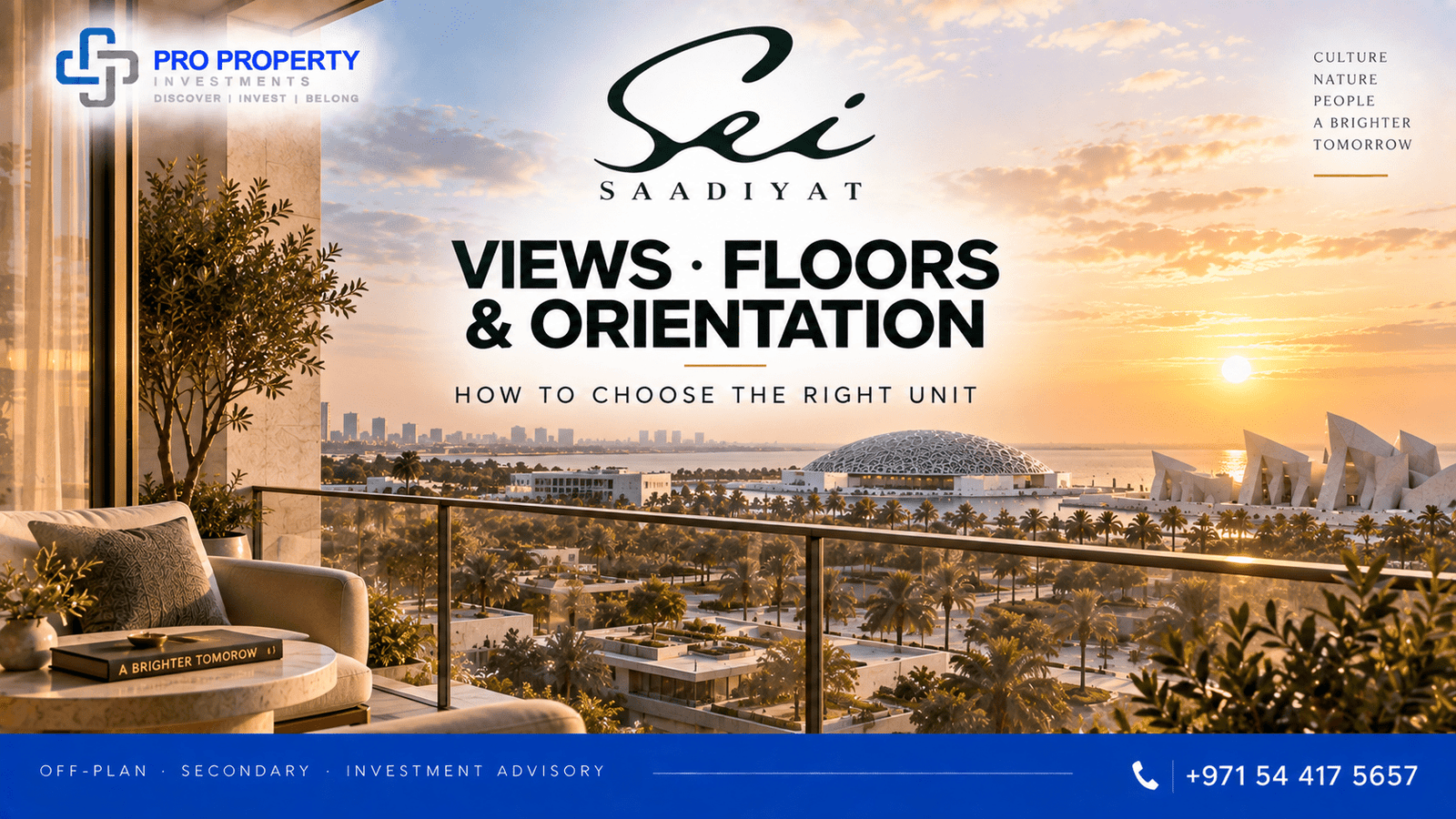
At Sei Saadiyat, position deserves particular attention because Aldar is explicitly designing the project around light, open views, landscaped spaces and a connection to Saadiyat Cultural District. The development will contain six residential towers and 778 homes, ranging from 1 and 2-bedroom apartments to 2-bedroom Kanso Lofts and 3-bedroom Kanso Residences. Prices currently start from AED 2.95 million, with estimated Q4 2030 handover.
But Aldar has not publicly published a complete tower-by-tower stacking plan showing exactly where every Type 1, Type 2, Kanso Loft or Kanso Residence sits.
The released dimensioned floor-plan pack also specifically does not state the tower stacking position of every layout.
That means no responsible brokerage should currently tell buyers:
“Stack 04 is definitely the best.”
or:
“Tower 5 will have the best permanent museum view.”
without developer inventory and masterplan documentation supporting that statement.
What we can analyse is something more useful:
Which types of views tend to be most defensible?
When is a higher floor actually worth paying more for?
How should buyers think about morning versus afternoon sun?
What is the difference between an open view and a permanent view?
And how much should a buyer pay for position before the premium stops making financial sense?
Quick answer: At Sei Saadiyat, the strongest units are likely to be those combining a defensible open outlook, useful natural light, privacy and a sensible acquisition premium. Cultural District or landmark-facing units may have strong resale storytelling; quieter landscaped views may provide better day-to-day calm; and higher floors can improve openness and privacy. But none of these characteristics should be bought at any price. The exact tower, future development around the unit and premium over comparable inventory need to be checked before reservation.
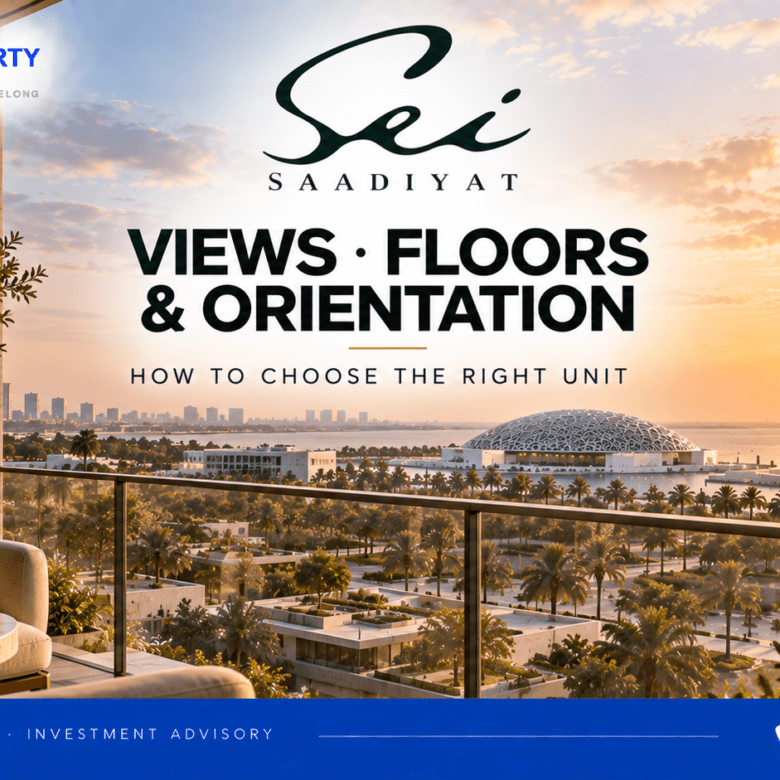
Why Views Matter More at Sei Saadiyat Than at a Generic Apartment Project
A view premium only makes sense when there is something worth looking at.
That is where Sei's location becomes important.
Aldar positions the project inside Saadiyat Cultural District, “moments from some of Abu Dhabi’s most celebrated cultural landmarks,” and describes the towers as being shaped around light, space and proportion. The developer also confirms that the project's rooftop pools and social gardens will overlook the Cultural District.
This means views are not incidental to Sei's concept.
They are part of the residential identity.
A unit can potentially relate visually to:
the Cultural District,
open skyline,
landscaped areas,
water or coastal horizons,
internal gardens,
or neighbouring development.
Those are not equivalent.
And by 2030, buyers will be able to experience the difference physically.
View Premiums Affect More Than Resale
Buyers often think of view only as an investment issue.
It is also a quality-of-life issue.
The view is one of the few parts of the apartment a resident cannot renovate.
You can replace flooring.
Change furniture.
Renovate a kitchen.
Upgrade lighting.
A weak outlook remains a weak outlook unless the surrounding environment changes—and sometimes that change makes it worse.
That makes the view relevant to:
natural light,
privacy,
how large the apartment feels,
balcony use,
emotional appeal,
rental demand,
and eventual resale.
For an owner occupier who spends ten years in the residence, those factors can matter more than a small difference in purchase price.
What Are the Main View Categories Buyers Should Expect to Compare?
Without inventing tower positions, Sei buyers can think about views in several broad categories.
Cultural District / Landmark Outlook
This is probably the most obvious premium category.
A residence whose main living area genuinely looks toward recognisable Cultural District architecture can have strong emotional and marketing value.
The advantage is not simply prestige.
Landmarks give a property a story.
A future seller can communicate:
“Open Cultural District view.”
That is easier to understand internationally than:
“Unit 1206 in Tower X.”
For overseas resale especially, recognisable location context can help differentiate the asset.
But “Cultural District View” Can Mean Almost Anything
This is where buyers need discipline.
One broker may use the phrase for a panoramic outlook.
Another may use it for a partial angled glimpse between buildings.
A third may describe the direction of the apartment rather than an unobstructed actual view.
Those are materially different assets.
Before paying a premium, ask for the exact:
tower,
stack,
orientation,
floor,
view corridor,
and surrounding masterplan.
If available, ask for a developer view diagram rather than relying only on a sales description.
A view category is not enough.
The quality of that view matters.
Landmark View vs Open View
These terms should not be treated as synonyms.
A landmark view means the apartment visibly relates to a recognisable building or destination.
An open view means the apartment has a relatively unobstructed visual field.
Sometimes the best property has both.
But not always.
An apartment can have a partial landmark view while another unit faces a broader open landscape with much greater sky, light and privacy.
For actual living, the second unit may feel better.
For marketing, the landmark-facing unit may be easier to describe.
That is why buyers should distinguish visual experience from sales terminology.
Open Views Can Create a Strong Sense of Space
Aldar repeatedly links Sei with open views, light and space.
This matters because visual openness can make an apartment feel larger than its internal dimensions suggest.
A 1-bedroom facing open sky and landscape may feel less confined than a larger apartment facing another façade at short distance.
The effect becomes especially important in living rooms with substantial glazing.
The apartment ends visually at the horizon rather than at the opposite building.
That can be difficult to quantify.
But premium buyers often respond strongly to it.
Internal Landscaped Views Should Not Be Dismissed
Not every buyer needs the most outward-facing unit.
Sei is also being designed around landscaped spaces, including a Pod Garden, Zen Garden and Serenity Pool.
An apartment facing a well-designed internal landscaped environment could have several advantages:
more visual greenery,
potentially calmer atmosphere,
less exposure to surrounding roads,
and a stronger sense of privacy depending on tower spacing.
For an end user, a beautifully landscaped outlook may be more enjoyable than an urban landmark view.
The trade-off can be lower perceived prestige or greater risk of another tower being visible across the courtyard.
Again, actual distance matters.
A Good Internal View Can Beat a Bad “Premium” View
This is a point buyers often miss.
Imagine two apartments.
Apartment A is marketed as:
“Cultural District facing.”
But the landmark is visible only from one corner of the balcony and a large residential building dominates the rest of the outlook.
Apartment B faces an internal landscaped garden with greater visual openness and better privacy.
Which is better?
The marketing language might favour Apartment A.
Daily life may favour Apartment B.
Luxury property should be judged with your eyes, not only category labels.
Water or Coastal-Horizon Views Can Be Particularly Powerful
Saadiyat's island setting means some orientations across the broader district may benefit from water, coastline or distant-horizon relationships.
If a Sei unit has a genuinely protected water-related outlook, that can potentially become a strong differentiator.
Water views tend to communicate easily to both local and international buyers.
But the same principle applies:
verify permanence.
An open plot between the apartment and water is not automatically a permanent water view.
Future development needs to be checked before paying a premium.
The Most Important Concept: Permanent View vs Temporary View
This may be the single most important section in the entire article.
A view today is not necessarily the view in 2030.
Saadiyat Cultural District continues to develop.
If an apartment currently overlooks vacant land, buyers need to know:
What is planned on that land?
A temporary open outlook can disappear when another residential or cultural building is constructed.
That can affect:
light,
privacy,
view,
noise,
and eventual resale appeal.
Therefore:
Do not pay a permanent-view premium for a temporary view.
Aldar's current public Sei page confirms the project's location and broad design philosophy, but it does not publicly provide enough tower-by-tower information to independently guarantee permanent views for individual units.
This is where unit-specific developer documentation becomes essential.
How Can a Buyer Verify a View?
Before reservation, PPI should ideally obtain as much of the following as Aldar makes available:
the site plan,
tower location,
unit stack,
floor level,
orientation,
surrounding plots,
masterplan,
and any official view diagrams or unit-position illustrations.
Then ask:
What exists in front of the apartment today?
What can legally or realistically be built there later?
How high could that future structure be?
Will the landmark remain visible?
Is the open corridor protected by water, road, park or permanent public realm?
A view protected by something that cannot easily be built on is generally more defensible than one relying on an undeveloped plot.
Does a Higher Floor Automatically Mean a Better Apartment?
No.
Higher floors often bring advantages.
But “higher = better” is too simplistic.
The premium should buy something tangible.
A higher floor can improve:
privacy,
open sky,
distance from road activity,
view depth,
and possibly landmark visibility.
But if floor 12 and floor 18 have essentially the same outlook, paying a huge premium for six additional floors may not make commercial sense.
The correct question is:
What changes when I go higher?
If the answer is “almost nothing,” the premium deserves scrutiny.
When a Higher Floor Is Worth Paying For
A high-floor premium becomes easier to justify when it materially improves one or more of these factors:
the apartment clears a neighbouring building;
a landmark becomes visible;
the water horizon opens up;
road noise reduces;
privacy materially improves;
or the view becomes substantially broader.
Those are real benefits.
You are purchasing an improved property experience.
When a Higher Floor May Not Be Worth It
A higher floor can be poor value when:
the outlook remains unchanged;
the same obstruction exists;
the premium is disproportionately large;
or a lower unit actually has a more attractive relationship with landscaping.
Some buyers also prefer lower floors because they feel more connected to gardens and the public realm.
There is no universal best floor.
There is only a best floor relative to the unit and price.
Lower Floors Can Have Their Own Premium Qualities
Premium residential buyers sometimes underestimate lower-level apartments.
A lower floor can work beautifully when it overlooks:
mature landscaping,
a garden,
water feature,
or a large internal courtyard.
It can feel closer to nature.
This can align strongly with Sei's landscape-and-stillness identity.
The risks include:
less privacy,
greater activity below,
more direct visibility from neighbouring areas,
and possibly more sound.
The actual relationship between tower and landscape determines whether the lower floor feels premium or exposed.
Mid Floors May Offer the Best Value
In many apartment projects, the strongest value does not sit at either extreme.
Mid-floor residences can offer:
good privacy,
meaningful open views,
less road exposure,
and a lower premium than the highest floors.
For an investor, this can be particularly attractive.
The unit does not need to be the best apartment in the entire tower.
It needs to provide enough advantages that a future buyer or tenant clearly prefers it over weaker alternatives.
That is a different objective from buying the prestige floor at any price.
Orientation: Why Direction Matters in Abu Dhabi
The orientation of a residence affects much more than the view.
It influences:
sunlight,
heat,
balcony usability,
interior brightness,
and how the apartment feels at different times of day.
In Abu Dhabi's climate, those factors deserve serious attention.
An apartment receiving attractive natural light can be desirable.
An apartment absorbing intense direct afternoon sun through extensive glazing can feel very different.
Façade design, shading and glazing specifications also matter, so compass direction should never be analysed in isolation.
East-Facing Units: Morning Light
An east-facing residence generally receives stronger morning sun.
For many residents, this can be attractive.
The home brightens earlier in the day.
Balconies can be more comfortable later in the afternoon once the direct sun has moved.
For someone who values morning light and uses outdoor space later in the day, an easterly orientation may work well.
The drawback is that a buyer who specifically wants evening sunset light may prefer another direction.
West-Facing Units: Sunset Appeal vs Afternoon Heat
West-facing residences can offer dramatic evening light and sunset potential.
That can be emotionally powerful in a premium home.
But west-facing glazing can also receive stronger late-afternoon solar exposure.
In Abu Dhabi, that should not be dismissed.
A spectacular sunset can come with:
greater heat gain,
stronger glare,
and more challenging balcony use during hot periods.
The building's shading and glass specification can mitigate this, but buyers should consider the trade-off rather than assuming sunset automatically means superior.
South-Facing Exposure
South-facing façades in the Northern Hemisphere typically receive substantial sun exposure across the day and year.
In Abu Dhabi, strong solar conditions make external shading and façade design particularly important.
A south-oriented property may be bright, but whether that is desirable depends on:
window area,
balcony depth,
architectural shading,
and view.
Orientation is only one component of performance.
North-Facing Exposure
North-facing residences can receive softer, more indirect light for much of the day.
Some buyers prefer this because interiors can feel bright without the same intensity of direct solar exposure.
Others may perceive the apartment as less dramatic than a sun-filled east or west-facing unit.
Again, there is no universal winner.
For a long-term end user, comfort can matter more than photographic drama.
Corner Units Can Be Particularly Attractive
Corner apartments can potentially provide:
more glazing,
multiple orientations,
better cross-view relationships,
and greater separation from neighbours.
This can create an especially strong sense of openness.
But corner status should not automatically command an unlimited premium.
Additional façade exposure can also mean:
greater solar exposure,
different furnishing constraints,
and more complex window treatments.
The view on both sides matters.
A corner apartment with one spectacular outlook and one weak façade relationship needs to be evaluated honestly.
Privacy Can Be More Valuable Than Height
One of the most underrated luxury-property features is simply not looking directly into someone else's home.
Tower-to-tower spacing matters.
Window alignment matters.
Balcony positioning matters.
A high floor is not automatically private if another high-rise sits directly opposite.
Likewise, a mid-floor apartment overlooking permanent open space can have excellent privacy.
Before paying for floor level, examine the actual relationship between buildings.
Bedroom Privacy Matters Separately From Living-Room View
This becomes particularly important in larger units.
A residence may have an excellent living-room outlook while a bedroom faces another tower at close distance.
For a family, that can materially affect quality of life.
Buyers should therefore evaluate the apartment façade room by room.
Ask:
What does the living room face?
What does the primary bedroom face?
What do the secondary bedrooms face?
What does the balcony face?
A single “view” label may hide several different realities inside the same residence.
Kanso Lofts Need Especially Strong View Analysis
The Kanso Loft is a double-height duplex product.
That makes view and glazing particularly important because vertical volume is one of the residence's defining architectural features. The released floor plans confirm two-level Type A and Type B configurations.
A dramatic double-height window looking toward an exceptional open view could become one of the strongest features in the entire project.
The same architectural volume looking directly at another building may lose much of its emotional value.
For Kanso buyers:
view quality should carry more weight than usual.
You are paying a premium partly for architecture.
The outlook should reinforce that architecture.
The 3BR Kanso Residence Has a Different View Priority
The 3-bedroom Kanso Residence is more strongly family-oriented.
Its released plan contains three bedrooms, two studies, a maid's room and a substantial 8.9 × 4.7 metre living-and-dining area.
For this buyer, one spectacular living-room view may not be enough.
A family should examine:
bedroom privacy,
balcony orientation,
children's-room exposure,
study light,
and whether the residence remains comfortable throughout the day.
The decision is more complex because more rooms interact with the façade.
Smaller Apartments Need Differentiation Even More
A standard one-bedroom apartment is easier for future buyers to substitute.
There may be several 1BR units for rent or resale at the same time.
This makes unit-specific differentiation particularly valuable.
Imagine five one-bedroom Sei apartments listed around similar prices.
The future tenant or buyer can compare:
higher floor,
better view,
more privacy,
orientation,
and price.
The apartment with the clearest advantage has a stronger reason to be selected.
For smaller investor units, an excellent position can be disproportionately valuable.
Standard 2BR Buyers Should Prioritise Broad Appeal
The standard 2-bedroom is likely to attract a wider mix of:
couples,
professionals,
small families,
and investors.
For this category, the ideal unit may not need an extraordinary trophy view.
It needs a broadly desirable one.
Open enough.
Private enough.
Bright enough.
Easy to understand.
And sensibly priced.
That broad appeal can be more useful for liquidity than paying an extreme premium for one dramatic characteristic.
A View Premium Should Be Measured in Dirhams, Not Adjectives
Sales language can be persuasive.
“Iconic.”
“Panoramic.”
“Uninterrupted.”
“Landmark.”
“Premium.”
These words mean very little without a price comparison.
Suppose two otherwise comparable units cost:
Unit A — AED 4.5M
Unit B — AED 5.0M
and the main difference is view.
The buyer is not deciding whether the view is “better.”
They are deciding:
Is that view worth AED 500,000?
That is the correct financial question.
How to Analyse a View Premium Properly
A useful framework is to calculate both:
Absolute premium
and:
Percentage premium.
If Unit A costs AED 4.5M and Unit B costs AED 5.0M:
Absolute premium:
AED 500,000
Percentage premium:
approximately:
11.1%
Now ask:
Will future buyers also value the view enough to pay roughly that premium?
Will tenants pay proportionally more?
Is the view permanent?
Does it materially improve lifestyle?
If yes, the premium may be defensible.
If not, the cheaper apartment may be better value.
Do Not Assume Every Premium Is Recoverable at Resale
This is crucial.
A developer may charge a substantial premium at launch for:
floor,
corner position,
landmark outlook,
or a particular stack.
The future resale market does not automatically have to reimburse the owner for every dirham of that premium.
The market will decide what the feature is worth at that time.
A buyer can overpay for an excellent view.
The view can still be excellent.
The investment can still be poor.
Quality and valuation are separate concepts.
What Does Current Cultural District Pricing Tell Us?
Public market data show how premium the wider location already is.
Bayut's August 2026 index places apartments across Saadiyat Cultural District around AED 3,861 per sq ft, while off-plan apartments in the district sit around AED 3,770 per sq ft. The figures vary significantly by bedroom type and individual development.
For example, the same market index shows a material spread between projects inside the district rather than one uniform Cultural District price.
That is important.
It demonstrates that micro-location, project quality, product type and property-specific characteristics already influence pricing substantially inside the same broader district.
However, the public index does not isolate a clean percentage premium specifically attributable to floor or view.
Therefore PPI should not claim:
“Museum views always add 15%.”
There is no reliable public evidence supporting a universal Sei-specific number today.
Cultural District Projects Already Show Significant Price Dispersion
Current Bayut data place developments such as The Source, The Source II, Mamsha Gardens, Louvre Abu Dhabi Residences and other Cultural District properties at different price-per-square-foot levels despite sharing the same wider address.
This reinforces a key point:
“Saadiyat Cultural District” alone does not determine value.
Individual project quality matters.
And within the project, individual unit quality matters.
By 2030, Sei will likely develop its own internal pricing hierarchy as completed transactions establish which towers, floors and views buyers prefer.
Today, buyers have an opportunity to think about that hierarchy before it is fully visible in resale data.
The Best Unit Is Not Necessarily the Most Expensive Unit
This should become PPI's core unit-selection principle.
The best home may be the most expensive apartment with the strongest view.
The best investment might be the property one tier below it.
Why?
Because a unit can capture:
80–90% of the lifestyle advantage
while costing significantly less.
For example, a mid-high floor with an excellent open outlook could be stronger value than the absolute highest floor carrying a large prestige premium.
Investment value often exists in the gap between:
good enough to remain desirable
and:
priced as the trophy unit.
The Cheapest Unit Is Not Automatically the Best Investment Either
A low price can be attractive.
But ask why the unit is cheaper.
Lower floor?
Poorer view?
Road exposure?
Less privacy?
Future obstruction?
Less desirable orientation?
If the weakness also affects future buyers, the discount may be entirely justified.
The objective is not to buy the cheapest property.
It is to find:
the strongest relationship between price and desirability.
Should Investors Prioritise View or Floor Plan?
Both matter, but there is a practical hierarchy.
First, eliminate fundamentally weak floor plans.
Then compare the strongest remaining layouts by:
unit position,
view,
floor,
orientation,
and price.
A beautiful view does not fix an apartment that is frustrating to live in.
Likewise, a perfect floor plan can underperform if the residence is dark, exposed or directly obstructed.
Strong investments generally require both a good inside and a good outside.
Should End Users Pay More for the View Than Investors?
Potentially.
An end user receives daily personal utility from a premium outlook.
If a family loves a particular view and plans to live in the apartment for ten years, paying an additional premium may be rational even if the eventual financial return is not perfectly proportional.
An investor has a different test.
They need to ask whether future tenants or buyers will pay enough to justify the extra capital.
Neither approach is wrong.
They simply optimise for different returns:
financial return
versus:
financial + lifestyle return.
How Much Should a Buyer Stretch for a Better Unit?
There is no universal number.
But a useful discipline is to compare the premium with the total budget.
A buyer who planned to spend AED 4.5M may find a much better unit at AED 4.65M.
An additional AED 150,000—about 3.3%—could be easy to justify if it materially improves a permanent view.
An upgrade from AED 4.5M to AED 5.3M is different.
Now the buyer is allocating another AED 800,000.
At that point, compare whether the same capital could instead buy:
a larger unit,
a different project,
or a secondary-market property.
Every premium has an opportunity cost.
Avoid “Best View” Thinking Without Considering Buyer Profile
The best view for an investor may differ from the best view for a family.
An investor may prioritise:
recognisability,
resale storytelling,
and broad tenant appeal.
A family may prioritise:
privacy,
calm,
less solar exposure,
and bedroom outlooks.
A second-home buyer may want:
dramatic sunset,
Cultural District landmarks,
and emotional impact.
The same apartment can be perfect for one and poor for another.
This is why unit selection should begin with buyer intent.
View Quality Also Affects Photography and Marketing
This may sound superficial.
It is commercially important.
When a property is eventually listed for rent or sale, photographs become the first filter.
An apartment with a distinctive outlook photographs differently from one facing a nearby façade.
That can generate:
more listing attention,
more enquiries,
and stronger emotional engagement before the buyer even visits.
For premium resale, presentation matters.
A view is therefore not only something the resident experiences.
It can become part of the property's future marketing advantage.
Balcony Orientation Matters Too
Sei's released floor plans include balcony relationships across multiple residence types.
A balcony adds value only when people want to use it.
Buyers should consider:
view,
depth,
privacy,
sun,
wind,
and relationship to the living room.
A beautifully sized balcony receiving intense afternoon sun may be used differently from a shaded morning-oriented balcony.
A private balcony can feel like an extra room.
An exposed balcony facing neighbours can become decorative rather than functional.
How PPI Should Compare Two Units
Instead of saying:
“This one has the best view.”
PPI should build a comparison like this:
| Factor | Unit A | Unit B |
|---|---|---|
| Price | ||
| Floor | ||
| Layout | ||
| Orientation | ||
| Main View | ||
| View Permanence | ||
| Living-Room Privacy | ||
| Bedroom Privacy | ||
| Balcony Usability | ||
| Direct Sun Exposure | ||
| Future Obstruction Risk | ||
| Premium vs Comparable Unit |
This turns unit selection from emotion into structured analysis.
There is still room for preference.
But the buyer knows what they are paying for.
Why the Current Lack of Public Stacking Data Makes Brokerage Advice More Valuable
The released floor plans are useful but do not currently publish the stacking position of each layout within Sei's six towers.
Aldar's official project page confirms the towers and broad design principles but likewise does not publicly display detailed unit-by-unit stacks in the material currently accessible.
That means generic online content can only go so far.
Once PPI has live Aldar inventory, the real advisory value comes from matching:
the actual unit number,
the actual plan,
the actual tower,
the exact price,
and the actual view information.
That is far more useful than publishing twenty pages that all repeat:
“great views.”
Why Pro Property Investments (PPI) Matters in Unit Selection
This is exactly the stage where Pro Property Investments (PPI) can position itself as an advisor rather than simply another property portal.
PPI works across Abu Dhabi off-plan and secondary-market property, allowing buyers to compare Sei inventory not only against other units inside the project but against existing Saadiyat homes where actual views and completed environments can already be inspected.
For Sei, PPI should help the buyer answer:
Is the premium view genuinely permanent?
Does the higher floor materially improve the apartment?
Is the corner unit worth the extra money?
Will afternoon sun affect the living space?
Is the landmark visible from the living room or only from one balcony angle?
Could another project offer a stronger view for the same budget?
And most importantly:
Would a future buyer pay for the same advantage I am paying for today?
That final question is where lifestyle and investment analysis meet.
PPI's team can help clients compare live inventory, floor plans, orientation, pricing and available secondary alternatives rather than allowing the developer's most expensive unit to automatically become the recommendation.
For current Sei Saadiyat unit availability and view-by-view comparison, contact Pro Property Investments at +971 54 417 5657.
Frequently Asked Questions
What views will Sei Saadiyat have?
Aldar confirms open views and a location inside Saadiyat Cultural District, and states that rooftop pools and social gardens will overlook the district. Exact individual unit views depend on tower, stack, floor and surrounding development.
Has Aldar released a full Sei Saadiyat stacking plan?
The currently public floor-plan material provides dimensioned layouts but does not publish the stacking position of each layout within the towers.
Is a Cultural District view automatically the best?
No. View quality, openness, permanence, privacy and price all matter. A landscaped or wider open view can be stronger for some buyers than a partial landmark view.
Are higher floors always better?
No. Higher floors can improve openness and privacy, but the premium should be justified by a real improvement in view or living experience.
Are lower floors bad investments?
Not necessarily. Lower floors can benefit from landscaped outlooks, greater visual connection to gardens and lower acquisition premiums.
Which orientation is best at Sei Saadiyat?
There is no universal best orientation. East can provide morning light, west can offer evening and sunset light but stronger afternoon sun, while north and south exposures have different lighting and heat characteristics. The actual façade, shading and view should be analysed with orientation.
Are corner apartments better?
They can offer greater glazing, multiple orientations and openness, but should still be evaluated for solar exposure, privacy and the quality of both outlooks.
Is a sea or water view worth paying more for?
Potentially, especially when the outlook is permanent and clearly visible from primary living spaces. The premium should still be compared with similar units.
What is a permanent view?
A view protected by a feature unlikely to be built over—such as established public realm, water or a protected corridor—is generally more defensible than an outlook over an undeveloped plot.
Can a temporary open view disappear?
Yes. Saadiyat Cultural District continues to develop, so buyers should check what is planned on surrounding land before paying an open-view premium.
Does view affect rent?
It can influence tenant preference and potentially rent, but there is no reliable public Sei-specific percentage showing how much each view category will add.
Does view affect resale?
Potentially. A distinctive, defensible outlook can help differentiate one apartment from competing resale inventory.
What is the current average Cultural District apartment price?
Bayut's August 2026 index places apartments in Saadiyat Cultural District at approximately AED 3,861 per sq ft, while off-plan apartments average around AED 3,770 per sq ft. Individual projects and units vary materially.
Can I rely on the project rendering to understand my unit's exact view?
No. Project renders illustrate the development concept. Buyers should use unit-specific developer documentation and masterplan information for view analysis.
Are Kanso Lofts more sensitive to view quality?
Potentially, yes. Their duplex and double-height architecture makes glazing and visual openness a larger part of the residence's value proposition. The released plans confirm the two-level Kanso configurations.
Final Analysis: Which Sei Saadiyat Unit Position Could Be Strongest?
There is no responsible way today to say:
Tower X, floor Y, stack Z is the absolute best Sei Saadiyat investment.
The public information is not yet detailed enough for that.
What we do know is that Aldar has deliberately built Sei around:
light, space, landscaped areas and open views within Saadiyat Cultural District.
That makes unit position an important part of the buying decision.
The strongest apartment will probably combine several characteristics:
a good floor plan,
a genuinely open or recognisable outlook,
reasonable privacy,
comfortable solar orientation,
limited future obstruction risk,
and a purchase premium that future buyers can understand.
For a prestige-focused buyer, a strong Cultural District or landmark relationship may be particularly compelling.
For an end user, a quieter landscaped view may be better.
For an investor, the strongest choice may be the unit that captures much of the premium experience without paying the maximum premium in the project.
And for a Kanso buyer, architectural volume and view should ideally reinforce one another.
The biggest mistake is paying a premium based on a label.
“High floor.”
“Cultural view.”
“Corner.”
“Premium stack.”
Each phrase needs to translate into a visible, permanent and commercially defensible advantage.
That is the standard PPI should use.
Before choosing a unit, compare the actual view, exact price and future masterplan, not just the brochure category.
For unit-specific Sei Saadiyat availability and view analysis, contact Pro Property Investments (PPI) at +971 54 417 5657
Join The Discussion