



Buying property in another country creates a very different set of questions from buying in your home market.
The architecture may attract you first.
The location may convince you to investigate further.
But before an international purchaser transfers money, the questions usually become much more practical.
Can I legally own the property?
Do I need to live in the UAE first?
What exactly will I own?
How are my off-plan payments protected?
Can the property support a UAE Golden Residency application?
What fees sit outside the advertised price?
And perhaps most importantly:
Can I complete the purchase if I live overseas?
For foreign buyers considering Sei Saadiyat by Aldar, these questions are especially relevant because the project sits inside Saadiyat Cultural District, one of Abu Dhabi's established investment-zone markets.
Abu Dhabi law permits non-UAE natural and legal persons to own and acquire principal and accessory real-estate rights within designated investment areas. Official Abu Dhabi Real Estate Centre data also shows that investment zones are actively attracting international capital: non-resident investors from 116 nationalities participated in the Abu Dhabi property market during H1 2026, while investment zones attracted approximately AED 75 billion during the period.
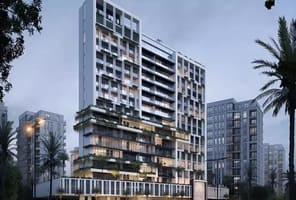
Sei Saadiyat itself is being developed by Aldar as a six-building community containing 778 residences, including 1 and 2-bedroom apartments, 2-bedroom Kanso Lofts and 3-bedroom Kanso Residences. Aldar currently lists prices from AED 2.95 million, a 5% down payment, 50/50 payment plan and estimated completion in Q4 2030.
For an overseas investor, that starting price is also significant because it exceeds the AED 2 million property-value level referenced by the UAE's Federal Authority for Identity, Citizenship, Customs and Port Security for the real-estate investor Golden Residency category.
But there is an important distinction:
Buying a AED 2.95 million property does not automatically mean receiving a Golden Visa.
Property ownership and residency are connected issues, but they are not the same legal process.
This guide explains both.
Quick answer: Foreign nationals can own property within Abu Dhabi investment areas, and Saadiyat Island forms part of Abu Dhabi's investment-zone market. Sei Saadiyat currently starts from AED 2.95 million, above the AED 2 million property-value level referenced for UAE real-estate investor Golden Residency. However, Golden Residency has separate eligibility, ownership and documentation requirements, so purchasing Sei Saadiyat should never be marketed as automatic visa approval.
Sei Saadiyat for International Buyers at a Glance
| Question | Current Position |
|---|---|
| Can foreigners own in Abu Dhabi? | Yes, within designated investment areas |
| Is Saadiyat part of the investment-zone market? | Yes |
| Sei Saadiyat Developer | Aldar |
| Starting Price | AED 2.95 million |
| Initial Payment | 5% |
| Payment Plan | 50/50 |
| Expected Handover | Q4 2030 |
| Property Types | 1BR, 2BR, Kanso Lofts, 3BR Kanso Residences |
| Golden Residency Property Threshold | AED 2 million |
| Automatic Golden Visa with purchase? | No |
| Off-plan buyer payments | Regulated project escrow |
| Off-plan SPA registration | Registered through ADREC |
| Foreign buyer participation in Abu Dhabi | Investors from 116 nationalities in H1 2026 |
Official Abu Dhabi data shows international participation is already significant: resident expatriates and non-resident foreign purchasers together represented 70% of residential sales value in H1 2026.
That makes foreign ownership an established part of Abu Dhabi's residential market rather than a niche exception.
Can Foreigners Buy Property in Abu Dhabi?
Yes—but location matters.
Under Abu Dhabi's property ownership framework, non-UAE natural and legal persons can own and acquire principal and accessory real rights over property located within designated investment areas and can dispose of those rights.
This is the key legal concept international buyers need to understand.
Foreign ownership is not simply determined by whether a building is marketed internationally.
The property must fall within an area where the relevant ownership rights are available to non-UAE buyers.
Abu Dhabi has continued expanding these areas.
By H1 2026, ADREC reported 50 investment zones across the emirate after eight additional zones were approved during the first half of the year.
This growing network is one reason Abu Dhabi has become increasingly accessible to overseas property investors.
Can Foreigners Buy at Sei Saadiyat?
Yes, Sei Saadiyat sits within the Saadiyat Island investment market.
ADREC's H1 2026 market analysis specifically identifies Al Saadiyat Island among the main districts within Abu Dhabi's investment-zone residential stock.
That means the project is positioned in the part of the Abu Dhabi property market designed to accommodate ownership and investment by different nationalities.
For an international buyer, this distinction is important.
A buyer should never assume that property ownership rights are identical across every location in the emirate.
But Saadiyat is already one of Abu Dhabi's best-established international investment destinations.
Do You Have to Be a UAE Resident to Buy?
Abu Dhabi's investment-zone ownership framework permits non-UAE natural and legal persons to own qualifying real estate within those areas.
The market data itself demonstrates that ownership activity is not limited to UAE residents.
ADREC recorded participation from non-resident investors representing 116 nationalities during H1 2026.
Therefore, an overseas buyer does not need to become a UAE resident merely in order for foreign property ownership in an investment zone to be conceptually possible.
That said, transaction procedures, banking, identity verification, financing and residency applications are separate matters.
For example, a non-resident may be legally able to acquire the property while finding mortgage eligibility more restrictive than a UAE resident.
A buyer's nationality, residence status and financing strategy should therefore be considered separately rather than treating “foreign buyer” as one uniform category.
Why Saadiyat Is Particularly Relevant to International Buyers
Saadiyat is one of the easiest Abu Dhabi locations for a foreign purchaser to understand conceptually.
Its international identity is built around cultural institutions, premium real estate, beaches, hospitality and landmark architecture.
Sei Saadiyat sits specifically within Saadiyat Cultural District, close to major cultural destinations rather than in a peripheral residential expansion area.
That gives the project a narrative that translates well internationally.
An overseas purchaser may never have lived in Abu Dhabi but may already recognise Louvre Abu Dhabi or be familiar with Saadiyat's museums and cultural development.
That global recognition can matter.
Property markets depend partly on how easily future buyers understand the location.
An internationally recognisable district potentially draws from a wider audience than one known mainly to local residents.
Abu Dhabi Foreign Investment Is Growing Rapidly
The scale of foreign participation provides important context.
ADREC reported that foreign direct investment in Abu Dhabi real estate reached AED 13.8 billion during H1 2026, representing a 309% year-on-year increase and already exceeding the total foreign direct investment recorded during the whole of 2025.
Leading foreign investment source markets included the United Kingdom, China, Russia, the United States, Germany and France.
More broadly, investment zones attracted:
AED 75 billion during H1 2026
compared with AED 26.7 billion in the comparable prior-year period.
These statistics do not guarantee that Sei Saadiyat prices will rise.
They demonstrate something different:
the international buyer base supporting Abu Dhabi real estate is already substantial and increasingly diverse.
For future liquidity, this matters.
A property market supported by purchasers from multiple countries is less dependent on one narrow source of demand.
Why Sei Saadiyat May Appeal to Overseas Buyers
Sei Saadiyat combines several characteristics international purchasers commonly look for.
It is being developed by a recognised Abu Dhabi developer.
It sits within an established investment-zone market.
It offers a multi-year off-plan payment structure rather than requiring the entire purchase value immediately.
Its Cultural District location is globally understandable.
And its advertised starting price sits within the premium rather than entry-level segment.
This makes the project particularly relevant to international purchasers seeking a combination of UAE property exposure, long-term capital positioning, personal use and potentially residency-related benefits.
But each of those objectives should be analysed independently.
A property should not be purchased solely because it might help with residency.
And residency should not be treated as evidence that a property itself is financially attractive.
How Much Does a Foreign Buyer Need to Start?
Aldar currently advertises Sei Saadiyat from AED 2.95 million, with 5% down and a 50/50 payment plan.
At the advertised starting price:
| Calculation | Amount |
|---|---|
| Property Price | AED 2,950,000 |
| 5% Initial Payment | AED 147,500 |
| Total 50% Pre/Handover-Stage Portion | AED 1,475,000 |
| Remaining 50% | AED 1,475,000 |
| Estimated Handover | Q4 2030 |
The AED 147,500 figure is important.
But international buyers should not interpret it as:
“I can buy a Saadiyat property for AED 147,500.”
That is only the initial portion of a contractual commitment approaching AED 3 million at the entry level.
Foreign investors need to plan for the complete acquisition.
International Buyers Should Think in AED, Not Only Their Home Currency
This is an often-overlooked issue.
The purchase commitment is denominated in UAE dirhams.
A buyer in the United Kingdom may think in pounds.
A European investor may think in euros.
An Indian buyer may think in rupees.
A Chinese purchaser may think in renminbi.
But the property remains an AED obligation.
Because the UAE dirham is pegged to the US dollar, buyers whose income or capital is held in other currencies can experience exchange-rate movements during the construction period.
Imagine committing to a future AED 1.475 million handover payment.
The amount in dirhams does not change merely because your home currency weakens.
But the amount of home-currency capital required to produce those dirhams can increase.
For a multi-year off-plan purchase, currency planning therefore becomes part of property planning.
How Does an Overseas Buyer Purchase Sei Saadiyat?
The process is relatively straightforward conceptually, although individual documentation and transaction requirements can vary.
A foreign purchaser typically moves from property selection into reservation, identity and compliance checks, initial payment, signing the Sale and Purchase Agreement, registration of the off-plan transaction and then ongoing construction payments.
In Abu Dhabi, ADREC states that every off-plan sale is registered through an SPA, and the registered SPA can be visible to the buyer through the regulatory platform.
Buyer payments for registered off-plan developments are also required to flow through regulated project escrow arrangements rather than simply being treated as unrestricted developer funds.
For an overseas investor, those systems are important because they add regulatory structure around a purchase being made before the physical property is complete.
Step 1: Decide What You Are Buying the Property For
Before choosing the actual unit, an international investor should establish the objective.
Is this primarily an investment?
Future UAE home?
Second residence?
Long-term family asset?
Potential rental property?
Capital diversification outside the home country?
Or part of a wider relocation strategy?
The correct Sei Saadiyat unit can change depending on the answer.
A one-bedroom property may make sense for an overseas investor seeking a lower total entry point.
A two-bedroom plus maid may better suit someone planning eventual relocation.
A Kanso Loft may attract a design-focused international second-home buyer.
A 3-bedroom Kanso Residence makes more sense for a family expecting to occupy the property.
Buying purpose should therefore come before bedroom count.
Step 2: Verify the Exact Unit
International buyers can be especially vulnerable to buying from brochures because they may not be physically present during the launch.
Do not choose simply:
“one 2-bedroom please.”
Ask for the exact:
tower, unit number, floor, stack, total area, balcony or terrace, orientation, outlook, neighbouring structures, parking allocation and floor plan.
For Sei Saadiyat, this matters even more because selected residences are positioned around views toward Cultural District landmarks, the Arabian Gulf and wider Abu Dhabi skyline.
If a buyer is paying a premium for a view, they should understand whether future construction could alter it.
Step 3: Confirm the Total Purchase Price
A project's advertised “from” price is an entry level.
It does not mean every available residence costs the same.
Sei Saadiyat currently starts from AED 2.95 million, but larger two-bedroom apartments, maid's-room layouts, Kanso Lofts and Kanso Residences can require materially more capital.
The international buyer should therefore request an exact official quotation for the chosen unit.
This should clearly identify the unit and total sale price rather than relying on a screenshot or chat message.
Step 4: Understand the Payment Schedule Before Reserving
Sei Saadiyat currently offers a 50/50 payment plan with 5% down.
That broad structure is attractive.
But overseas buyers should obtain the complete instalment schedule associated with the actual reservation and SPA.
The questions to resolve are simple:
When is each amount due?
How much must be transferred?
Which account receives it?
What happens if payment is late?
What payment level must be reached before any assignment or resale is permitted?
And what remains due at handover?
The buyer should be able to map those obligations against their own cash flow before signing.
Step 5: Transfer Only to Verified Payment Instructions
Off-plan payments in Abu Dhabi are subject to project escrow controls.
ADREC states that off-plan developments must be registered and backed by licensed escrow accounts, and buyer payments are deposited into approved project escrow arrangements.
The Centre explains that the purpose of escrow is to protect investors and ensure that buyer funds are connected to the specific project and released according to verified construction progress.
For an international buyer, this means payment verification is essential.
Do not transfer a large amount simply because an agent sends bank details over WhatsApp.
The beneficiary, project, unit and reference details should align with official documentation.
Step 6: Complete the SPA and Registration
The Sale and Purchase Agreement is one of the most important documents in an off-plan purchase.
It governs matters such as the property being purchased, price, payment obligations, completion, default provisions and other contractual rights.
ADREC's current developer framework states that every off-plan sale is registered through the SPA and that buyer payments are then held through regulated project escrow.
An overseas purchaser should read the SPA carefully rather than treating it as an administrative formality.
For substantial transactions, obtaining independent legal advice can also be sensible, especially where the purchaser needs guidance on cross-border tax, inheritance or ownership structuring.
What Property Registration Fees Apply?
Abu Dhabi's current transaction services list real-estate registration fees at:
2% of the contract value
DARI also lists an AED 875 e-services fee on its general sale-and-purchase registration service, with additional mortgage-related charges where applicable.
For off-plan development registration, ADREC's developer guidance similarly references a fee equal to 2% of the unit sale price.
At an AED 2.95 million purchase price:
2% = AED 59,000
The actual allocation of applicable costs between buyer and seller or any promotional fee support should be confirmed from the transaction documentation rather than assumed.
For this reason, an overseas purchaser should always ask for a complete buyer cost sheet before reserving.
What About Brokerage Commission?
Abu Dhabi regulations set broker commission on sale and purchase contracts at 2%, subject to a maximum of AED 500,000.
However, this does not mean every developer-launch buyer should automatically add another 2% to their own budget.
The party responsible for brokerage commission depends on the transaction and commercial arrangement.
For a new-development transaction, commission may be structured differently than a secondary-market purchase.
The buyer should therefore establish in writing whether any brokerage fee is payable by them before reserving.
What About Mortgage Costs?
If a purchaser later finances part of the acquisition, additional charges can apply.
DARI currently identifies mortgage registration and mortgage-release fees among possible transaction costs.
Bank-specific costs may include valuation, processing, insurance or other financing charges.
An international investor considering mortgage funding at handover should therefore not assume that the only financing cost is the interest rate.
The complete loan structure matters.
Can Non-Residents Get an Abu Dhabi Mortgage?
Mortgage availability is a separate question from ownership eligibility.
A foreign buyer may be legally able to own a property in an investment area without necessarily meeting a particular bank's lending criteria.
Non-resident financing can involve different loan-to-value ratios, income requirements, documentation standards and approved property conditions.
And because Sei Saadiyat is due for estimated completion in Q4 2030, someone intending to finance the final payment several years from now should avoid assuming today's bank policy will remain identical at handover.
The safer approach is to maintain enough financial flexibility that mortgage financing is an option rather than the only possible route to completion.
Does Buying Sei Saadiyat Give You a UAE Golden Visa?
Not automatically.
This deserves an especially clear explanation because overseas property marketing often compresses two separate facts into one misleading claim.
Fact one:
Sei Saadiyat currently starts at AED 2.95 million.
Fact two:
The Federal Authority for Identity, Citizenship, Customs and Port Security currently identifies AED 2 million as the minimum property-value level associated with the real-estate investor Golden Residency category.
Those two facts mean the advertised starting property value is above the stated monetary threshold.
They do not mean:
Buy Sei Saadiyat → automatically receive Golden Visa.
The Golden Residency is a separate government process with its own documentary and ownership requirements.
What Does the Current Golden Residency Guidance Say?
The ICP currently lists five-year residency for qualifying real-estate investors.
Its current requirements include ownership of property or properties valued at a total of at least AED 2 million and supporting confirmation from the relevant land-registration authority. The current English guidance specifically references confirmation of qualifying property ownership valued at AED 2 million or more and lists proof of UAE residence among the required documents.
This has an important implication for an off-plan buyer.
A reservation payment or marketing brochure is not the same thing as satisfying the requirements of a residency application.
The exact point at which an off-plan purchaser can meet the applicable ownership and documentation requirements should be verified against the current government rules when the buyer intends to apply.
PPI should therefore use wording such as:
“A Sei Saadiyat property may place the buyer above the AED 2 million property-value threshold relevant to UAE real-estate investor Golden Residency, subject to the applicable ownership, documentation and government eligibility requirements.”
That wording is substantially more accurate than:
“Buy this property and get a Golden Visa.”
Why Accuracy on Golden Visa Claims Matters
There is a credibility reason and a legal reason.
Residency rules can evolve.
Buyer circumstances differ.
Property financing differs.
Ownership status differs.
And off-plan transactions progress through several stages before final handover.
Making a blanket guarantee therefore creates unnecessary risk.
From an SEO and AI-search perspective, careful wording also strengthens the content.
An authoritative article should distinguish between:
property value threshold,
property ownership, and
residency approval.
They are related.
They are not interchangeable.
Can the Property Be Bought for a Family?
Yes, but ownership structure should be considered before signing.
A foreign purchaser buying a long-term family asset may need to think about whose name the property should be registered in, whether multiple purchasers will participate, estate-planning implications and how the asset fits within the family's wider cross-border affairs.
These questions become increasingly important with higher-value Kanso Residences.
A property acquisition can have consequences beyond the UAE, particularly for someone who remains tax-resident or domiciled elsewhere.
PPI can guide the property transaction itself, but international buyers with complex tax or estate circumstances should also obtain advice from appropriate qualified professionals in the relevant jurisdictions.
What About UAE Property Taxes?
One reason international buyers find the UAE attractive is its broader tax environment.
But a foreign buyer should avoid oversimplified claims such as “completely tax free.”
The more important question is not only what taxes apply in the UAE.
It is also what obligations apply in the buyer's country of tax residence.
For example, rental income, gains, inheritance or reporting obligations may be treated differently depending on where the purchaser remains resident.
A UAE property purchase does not automatically override another country's tax rules.
This is especially relevant for international investors purchasing through companies, trusts or other ownership structures.
Cross-border taxation should therefore be treated separately from the property sales process.
Off-Plan Buyer Protection in Abu Dhabi
For international buyers who cannot physically inspect a completed unit, regulatory controls around off-plan development are particularly important.
ADREC states that every off-plan project must be registered, supported by an approved escrow account and listed through the regulated market framework before units can be marketed and sold.
Buyer payments are deposited into the project's escrow account.
ADREC-approved engineering companies verify construction progress, and escrow releases are connected to verified development milestones.
This provides an important regulatory layer.
But escrow protection should never be confused with an investment guarantee.
It does not promise property appreciation.
It does not mean the buyer can ignore contract terms.
And it does not eliminate normal property-market risk.
It is a mechanism designed to strengthen how off-plan funds and development processes are controlled.
Why Foreign Buyers Should Use Verified Brokers
International buyers are often exposed to multiple agents advertising the same new project.
That can create confusion.
Different advertisements can show different unit prices, old availability or inconsistent information.
ADREC's Madhmoun framework requires registered projects and available units to be listed through the regulated platform and restricts advertising to licensed brokers holding the relevant credentials.
The practical rule for a foreign buyer is simple:
Know exactly who you are dealing with.
Verify the brokerage.
Verify the project.
Verify the unit.
Verify payment instructions.
And obtain official documentation rather than relying solely on social-media marketing.
Can You Buy Sei Saadiyat Remotely?
International purchases increasingly involve substantial parts of the process being managed remotely.
The exact signing, verification and power-of-attorney requirements will depend on the transaction structure and documentation.
Therefore, an overseas buyer should tell the brokerage at the beginning if they do not expect to travel to Abu Dhabi during the purchase.
This allows the transaction team to identify early which documents must be signed, whether particular originals or attestations are required and how payment logistics will be handled.
Trying to solve those issues only when a deadline approaches is unnecessary.
Remote purchasing is primarily a documentation-management problem.
Solve it early.
What Documents Should a Foreign Buyer Prepare?
Exact requirements should always be confirmed for the actual transaction, but buyers should expect identity and compliance verification.
That generally means the purchaser needs valid identification and must satisfy the developer and transaction parties' KYC requirements.
Financed purchasers face additional bank documentation.
Corporate purchasers require additional company and beneficial-ownership information.
The important principle is to keep names consistent.
Your passport, reservation documents, bank-transfer references and SPA should not casually alternate between different spellings of the purchaser's name.
Small administrative inconsistencies can become larger registration problems later.
What Should a Foreign Buyer Check in the SPA?
This is one area where rushing is expensive.
The buyer should understand the property description, purchase price, payment dates, completion provisions, default consequences, notice procedures, assignment rights, any restrictions on resale during construction and the mechanisms governing delays or other contractual events.
The buyer should also understand exactly what is included in the delivered property.
Furniture shown in a rendering may not necessarily be included.
A spectacular view shown from a generic project image may not belong to the selected unit.
Marketing content creates interest.
The SPA and official schedules define the transaction.
Should an Overseas Investor Buy the Cheapest Unit?
Not necessarily.
International buyers sometimes focus too heavily on obtaining the lowest advertised entry price because they are unfamiliar with the project's micro-locations.
That can be a mistake.
A slightly more expensive unit may offer a substantially stronger outlook, higher floor, more efficient layout or better long-term desirability.
Because an international owner may eventually sell to another overseas buyer, easily understood features can matter:
sea view, Cultural District view, distinctive Kanso layout, corner position or particularly efficient floor plan.
The objective should not be to buy the cheapest Sei Saadiyat unit.
It should be to buy the unit with the strongest relationship between price and quality.
Which Sei Saadiyat Unit May Suit Foreign Buyers Best?
There is no universal answer.
A one-bedroom can suit an investor seeking the lowest entry point and simpler ownership.
A standard two-bedroom can appeal to buyers wanting a broader rental and resale audience.
A 2-bedroom with maid's room may suit someone planning eventual UAE residence because it offers more practical everyday space.
A Kanso Loft can appeal to a high-net-worth international buyer seeking a distinctive second home.
And a 3-bedroom Kanso Residence makes more sense for a family planning long-term occupation.
This is why PPI should advise international clients according to usage strategy, not nationality.
Is Sei Saadiyat Attractive for Portfolio Diversification?
For some buyers, yes.
An international investor may already own assets in their home country and want exposure to another currency, property market and economy.
Abu Dhabi can provide geographic diversification within a wider investment portfolio.
But diversification should not become an excuse to ignore concentration risk.
Buying a AED 7.5 million Kanso Loft is still a large exposure to one property.
A buyer should consider what proportion of their total wealth the acquisition represents and whether enough liquidity remains outside real estate.
The most financially secure buyer is not always the person who can technically complete the reservation.
It is the person who can complete the entire transaction without compromising the rest of their financial position.
Why the 2030 Handover Matters to Overseas Buyers
Aldar currently estimates Sei Saadiyat handover in Q4 2030.
For an international buyer, that creates both opportunity and planning risk.
The opportunity is time.
Capital is deployed across the construction period rather than entirely at launch.
The district continues developing.
The buyer can plan future relocation or investment strategy.
The risk is that four years is long enough for personal circumstances to change.
Employment changes.
Businesses change.
Exchange rates change.
Family plans change.
Mortgage policies change.
And property markets change.
Someone buying in 2026 should therefore select a property they are financially capable of completing even if their original 2030 plan evolves.
Why Foreign Demand Strengthens the Sei Saadiyat Investment Case
International demand does not guarantee appreciation.
But it can strengthen market depth.
ADREC reported that resident expatriates and non-resident foreign buyers combined accounted for 70% of Abu Dhabi residential sales value during H1 2026.
Saadiyat Island itself recorded approximately AED 13.3 billion of residential sales during the same period.
That combination is relevant.
The location already attracts significant capital.
The wider emirate already attracts substantial foreign participation.
Sei Saadiyat is therefore not relying entirely on a theoretical future international audience.
It is entering a market where foreign buyers are already central participants.
The Biggest Mistakes Foreign Buyers Should Avoid
The main risks are usually not exotic.
They are ordinary mistakes made at larger financial scale.
An international buyer should avoid purchasing solely because someone promises a Golden Visa, selecting a unit without studying the exact floor plan and future view, budgeting only the initial 5%, ignoring exchange-rate exposure, assuming a mortgage will automatically be available at handover, sending funds to unverified account details, signing an SPA without understanding payment and default provisions, and assuming that the most expensive unit must produce the best investment return.
Each of these mistakes is preventable.
Good transaction discipline matters more than sales urgency.
Frequently Asked Questions for Foreign Buyers
Can foreigners buy Sei Saadiyat?
Yes. Abu Dhabi law permits non-UAE persons to acquire qualifying real-estate rights within designated investment areas, and Saadiyat forms part of Abu Dhabi's investment-zone residential market.
Do I need UAE residency before buying?
The investment-zone ownership framework accommodates non-UAE purchasers, and ADREC reports active participation by non-resident investors from 116 nationalities. Property ownership and immigration residency are separate matters.
How much does Sei Saadiyat start from?
Aldar currently lists starting prices from AED 2.95 million.
How much is the initial payment?
The currently advertised down payment is 5%. On AED 2.95 million, that equals AED 147,500.
What is the payment plan?
Aldar advertises a 50/50 payment plan.
When is handover?
Estimated completion is Q4 2030.
Does Sei Saadiyat qualify for Golden Visa?
The project's advertised starting price exceeds the AED 2 million value referenced in current Golden Residency guidance, but residency eligibility requires separate ownership and documentary conditions and government approval. Buying the property does not itself guarantee Golden Residency.
How long is Golden Residency for real-estate investors?
The current ICP guidance lists five years for qualifying real-estate investors.
Is an off-plan reservation enough for Golden Residency?
Buyers should not assume so. Current federal guidance references qualifying property ownership and confirmation from the relevant land-registration authority. The requirements in force when applying should be checked directly.
Are off-plan payments protected?
Abu Dhabi requires registered off-plan projects to use regulated escrow arrangements, with buyer payments linked to the project and construction oversight.
Is the off-plan sale registered?
ADREC states that each off-plan sale is registered through the Sale and Purchase Agreement.
What is the property registration fee?
Current Abu Dhabi services list real-estate registration at 2% of contract value, with the specific transaction determining final cost allocation and other applicable charges.
Can I buy from outside the UAE?
International buyers can structure transactions while overseas, but exact identity, signing and documentation requirements should be established with the developer, brokerage and transaction parties for the specific purchase.
Can I rent the property after completion?
A residential investor can generally consider leasing the property after handover subject to applicable laws, community rules and transaction requirements. Rental economics should be assessed closer to 2030 rather than using speculative 2026 yield assumptions.
Final Verdict: Does Sei Saadiyat Make Sense for a Foreign Buyer?
Sei Saadiyat has several characteristics that make it particularly relevant to international purchasers.
The ownership environment is established.
Saadiyat sits within Abu Dhabi's investment-zone market.
Foreign participation in the emirate is substantial and growing.
The project is developed by Aldar.
The location has internationally recognisable cultural value.
The 50/50 payment structure allows capital to be deployed over time.
And the advertised AED 2.95 million entry price sits above the monetary level relevant to the UAE real-estate investor Golden Residency route.
But the purchase should still be approached as a property investment first.
Residency should be treated as a possible additional benefit subject to eligibility.
A low initial payment should not obscure the full financial commitment.
And an internationally recognised developer should not remove the need to examine the exact property being purchased.
For foreign buyers, the strongest Sei Saadiyat purchase is likely to be one that combines:
a defensible unit, strong view or layout, rational entry price, comfortable payment capacity and a clear long-term purpose.
The question is not merely:
“Can a foreigner buy Sei Saadiyat?”
The answer to that is comparatively straightforward.
The more important question is:
“Which Sei Saadiyat property should this particular foreign buyer own?”
That requires individual analysis.
For current availability, official floor plans, international-buyer guidance and unit comparisons, contact Pro Property Investments at +971 54 417 5657.


Join The Discussion