


Some property locations become valuable because developers construct luxury buildings there.
Others become valuable because something much harder to replicate develops around those buildings.
Saadiyat Cultural District belongs to the second category.
The district combines internationally significant museums, landmark architecture, education, art, tourism, waterfront living and some of Abu Dhabi's most premium residential real estate within one geographically concentrated destination.
By September 2026, much of the vision that was once discussed as a future Cultural District is already physically operating.
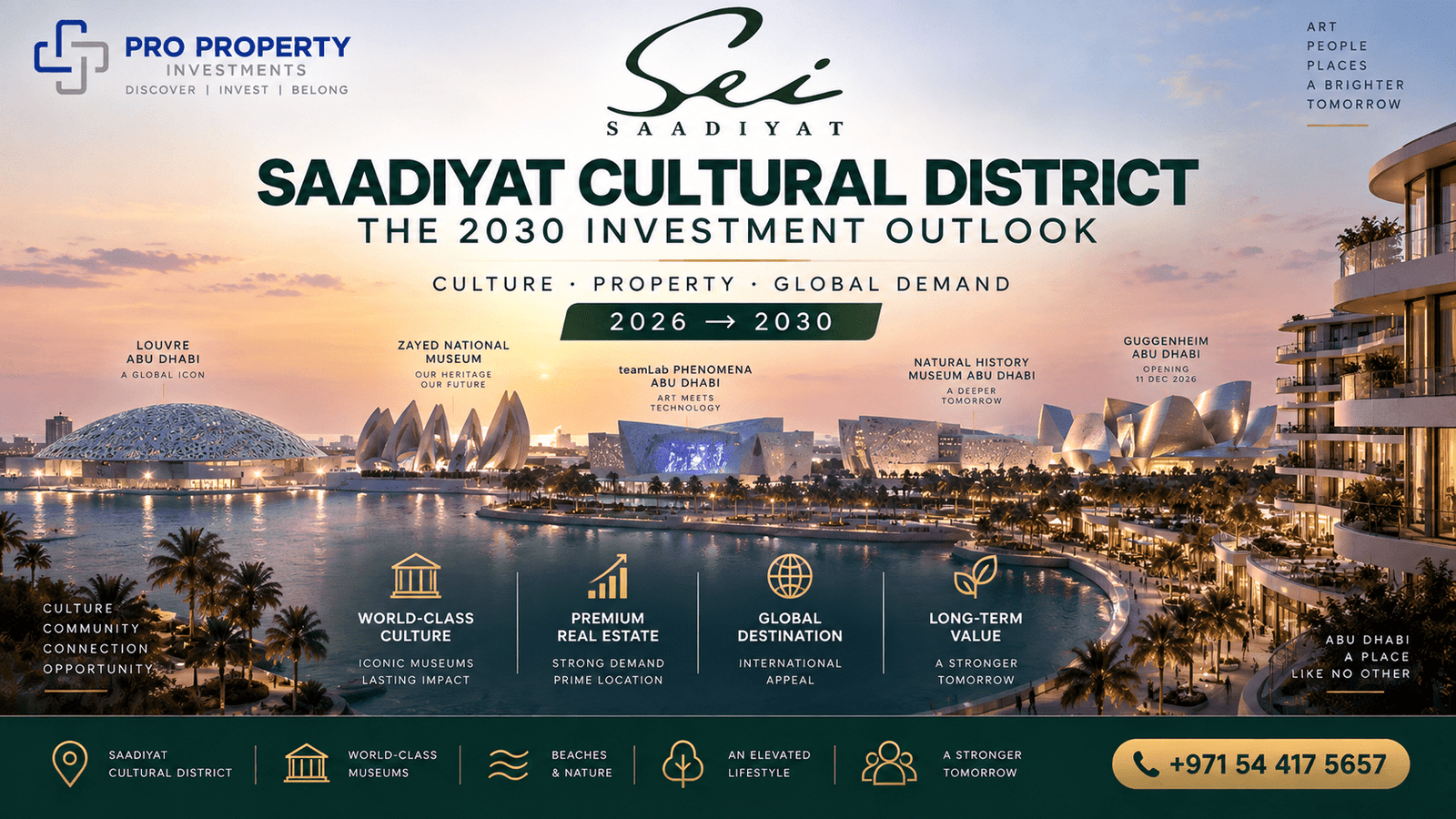
Louvre Abu Dhabi is established.
teamLab Phenomena Abu Dhabi opened in April 2025.
Natural History Museum Abu Dhabi opened in November 2025.
Zayed National Museum opened in December 2025.
And Guggenheim Abu Dhabi is scheduled to open on 11 December 2026, adding another internationally recognised institution to the district.
This evolution matters for real estate.
Property values are not determined by architecture alone.
They are influenced by the quality, scarcity, accessibility and reputation of the surrounding location.
And locations containing infrastructure that cannot easily be reproduced elsewhere can develop substantial long-term premiums.
That is the investment context behind Sei Saadiyat by Aldar.
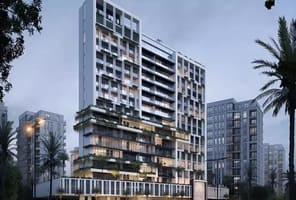
Sei Saadiyat is being developed directly within Saadiyat Cultural District as a six-building residential community containing 778 homes, with prices currently starting from AED 2.95 million, a 5% down payment, 50/50 payment structure and estimated completion in Q4 2030.
The timing is important.
Someone purchasing Sei Saadiyat in 2026 is not simply buying a future apartment.
They are purchasing a property scheduled to complete after another four years of development and maturation across one of Abu Dhabi's most strategically significant districts.
That creates the central investment question:
Could Saadiyat Cultural District become materially more valuable by the time Sei Saadiyat hands over in 2030?
No responsible analyst can guarantee that outcome.
But several fundamentals suggest the possibility deserves serious consideration.
Quick answer: Saadiyat Cultural District already combines functioning world-class museums, premium residential demand, substantial international investment and limited prime island positioning. Saadiyat Island recorded approximately AED 13.3 billion of residential sales in H1 2026, while Knight Frank identified it as Abu Dhabi's most premium apartment market at around AED 43,100 per sqm in June 2026. Sei Saadiyat's Q4 2030 delivery gives buyers exposure to several more years of Cultural District maturation, but future residential supply means unit quality and acquisition price remain critical.
Saadiyat Cultural District Investment Case at a Glance
| Factor | Current Position |
|---|---|
| Location | Saadiyat Island, Abu Dhabi |
| Cultural Institutions | Louvre, Zayed National Museum, Natural History Museum, teamLab Phenomena, Guggenheim Abu Dhabi and more |
| Guggenheim Opening | 11 December 2026 |
| Saadiyat H1 2026 Residential Sales | AED 13.3 billion |
| Current Premium Apartment Pricing | Approx. AED 43,100/sqm |
| Current YoY Saadiyat Apartment Price Growth | Approx. 21% |
| Foreign Participation | Resident expats + non-residents = 70% of Abu Dhabi residential sales value |
| Sei Saadiyat Handover | Q4 2030 |
| Sei Starting Price | AED 2.95M |
| Main Opportunity | Long-term destination maturation |
| Main Risk | Significant new premium supply through 2030 |
Current property-market figures come from ADREC and Knight Frank and describe the wider Saadiyat/Abu Dhabi market rather than guaranteed future Sei Saadiyat performance.
The Most Important Point: Saadiyat Cultural District Is No Longer Just a Masterplan
Years ago, an investor looking at Saadiyat Cultural District was largely investing in a promise.
The museums were planned.
The district was being developed.
Its international identity was still forming.
That is no longer the case.
The location now contains operating institutions whose scale and global relevance physically define the area.
This distinction matters greatly in property investing.
There is a difference between purchasing real estate beside a proposed attraction and purchasing beside an attraction already drawing visitors, programming exhibitions and becoming part of the identity of a city.
The investment risk profile changes as the infrastructure moves from concept to reality.
By 2026, Saadiyat Cultural District is increasingly becoming a functioning destination rather than a future proposition.
Louvre Abu Dhabi Established the International Identity
Louvre Abu Dhabi gave Saadiyat Cultural District something extremely valuable:
global recognition.
An internationally recognised cultural institution acts differently from a neighbourhood amenity.
A gym, community mall or landscaped park primarily serves local residents.
A major museum attracts tourists, international media, events, cultural programming, hospitality demand and wider destination investment.
It also permanently changes how a location is perceived.
“Near Louvre Abu Dhabi” is understandable to a person who has never previously lived in Abu Dhabi.
That is particularly important for premium property because high-end residential markets often depend on buyers from outside the immediate local neighbourhood.
A property location that requires twenty minutes of explanation has a different international resale proposition from one connected to recognised landmarks.
teamLab Added a Completely Different Audience
teamLab Phenomena Abu Dhabi opened on 18 April 2025 within Saadiyat Cultural District.
The 17,000-square-metre experience combines art, science, technology and interactive environments rather than functioning as a traditional museum.
This matters because cultural districts become stronger when their institutions are not all variations of the same experience.
A visitor who might not spend an afternoon studying conventional museum collections may still be attracted to immersive digital art.
Families may visit for one reason.
International art tourists for another.
Schools for another.
Young adults for another.
A diversified destination can therefore generate activity across more demographics and throughout more of the year.
For residential property, that helps create a neighbourhood with a genuine identity rather than a district that becomes quiet whenever one institution is closed.
Natural History Museum Expands Saadiyat Beyond Art
The Natural History Museum Abu Dhabi opened to the public on 22 November 2025.
At approximately 35,000 square metres, it became the largest museum of its type in the region, taking visitors across 13.8 billion years of natural history and incorporating education, research and public programming.
This institution expands the district's function beyond art and heritage.
Science.
Biodiversity.
Research.
Education.
Schools.
Families.
Academic engagement.
Those activities generate a different type of long-term destination relevance.
From a real-estate perspective, this matters because strong districts are usually multi-dimensional.
A neighbourhood based entirely around one tourist attraction may experience uneven demand.
A district combining culture, education, hospitality, residential property and everyday lifestyle can become far more resilient.
Zayed National Museum Gives the District National Significance
The Zayed National Museum opened in December 2025, becoming the UAE's national museum within the heart of Saadiyat Cultural District.
Its importance is fundamentally different from importing a global museum brand.
The museum is connected directly to the history, identity and heritage of the UAE.
That gives the district both international and national significance.
This combination is strategically powerful.
Saadiyat is not simply becoming “Abu Dhabi's museum neighbourhood.”
It is developing as a location where global institutions and the UAE's own national cultural identity coexist.
For property buyers, that helps create an address whose relevance is unlikely to depend on a single commercial cycle or entertainment trend.
Guggenheim Abu Dhabi May Be the Final Major Piece of the Cultural Cluster
The next major milestone is Guggenheim Abu Dhabi, designed by architect Frank Gehry.
Saadiyat Island's official destination website currently lists its opening date as:
11 December 2026
and positions the museum within the Guggenheim network alongside institutions in New York, Venice and Bilbao.
The relevance to property is not simply that another museum opens nearby.
The important factor is concentration.
One globally important cultural institution creates a landmark.
Several major institutions concentrated together create a district.
District-scale identity has much greater potential to influence surrounding land value because people do not merely travel there for one attraction.
Hotels, restaurants, retail, events, public spaces and residential communities can develop around the entire ecosystem.
Cultural Density Is Difficult to Replicate
This may be the most important long-term argument for Saadiyat Cultural District.
Luxury apartment buildings can be replicated.
Infinity pools can be replicated.
Marble lobbies can be replicated.
Private gyms can be replicated.
Even beaches can compete with other beaches.
What is much harder to reproduce is:
an internationally recognised cluster of cultural institutions occupying a premium island location within minutes of a major global city.
This creates what property investors might describe as a locational moat.
It does not guarantee rising prices.
But it gives the location something competing developments cannot easily manufacture.
That is particularly valuable over long holding periods.
Why Scarcity Matters in Premium Property
Premium real estate tends to derive more of its value from scarcity than mass-market property.
A buyer purchasing basic housing may compare thousands of units based primarily on size, commute and affordability.
A luxury buyer may pay large premiums for attributes that exist in limited supply:
waterfront;
landmark view;
private beach;
historic district;
financial centre;
golf course;
major park;
or cultural destination.
Saadiyat Cultural District combines several of these scarcity characteristics.
Island setting.
Culture.
Architecture.
Water.
Tourism.
Premium residential development.
And proximity to central Abu Dhabi.
That combination helps explain why Saadiyat already trades at the top end of the emirate's residential market.
The Market Is Already Pricing Saadiyat as Premium
Knight Frank reported in July 2026 that Al Saadiyat Island remained Abu Dhabi's most premium apartment location, with average transaction pricing of approximately:
AED 43,100 per square metre
as of June 2026.
That represented roughly 21% year-on-year growth.
Saadiyat also remained Abu Dhabi's most expensive villa location in Knight Frank's analysis, at around AED 26,500 per square metre.
These numbers are important for one reason:
The market is not waiting until 2030 to recognise Saadiyat as premium.
That premium already exists.
The investment question is whether further maturation of the Cultural District can sustain or expand it.
Transaction Volume Shows the Premium Is Not Just Theoretical
High prices are less meaningful if very few properties actually trade.
Saadiyat also has substantial transaction activity.
ADREC recorded approximately:
AED 13.3 billion
of residential sales on Saadiyat Island during H1 2026.
That placed Saadiyat second only to Hudayriyat Island among Abu Dhabi's leading residential sales districts during the period.
This gives investors evidence of market depth.
Buyers are not simply browsing luxury Saadiyat listings.
Billions of dirhams are actually transacting.
For future Sei Saadiyat owners, this matters because resale liquidity requires real buyers.
Abu Dhabi Is Also Attracting Much More International Capital
The broader emirate recorded:
AED 117 billion
in total real-estate transactions during H1 2026.
Foreign direct investment reached AED 13.8 billion, while non-resident investors from 116 nationalities participated in the market.
ADREC also reported that resident expatriates and non-resident foreign buyers together represented approximately:
70% of Abu Dhabi residential sales value
during H1 2026.
This is highly relevant to Saadiyat.
Premium property requires a sufficiently deep buyer pool.
If the only potential purchaser for a luxury apartment is a resident of one nearby neighbourhood, liquidity is limited.
An increasingly international buyer base can support premium areas because the address is marketed to a much wider pool of capital.
Why Cultural District Property Can Appeal to International Buyers
An overseas investor may not know every Abu Dhabi community.
They may not understand the difference between dozens of masterplans.
But globally recognised cultural landmarks reduce that knowledge barrier.
An apartment inside:
Saadiyat Cultural District
is easier to position internationally than an apartment described only through a building name.
The buyer can understand the broader context immediately.
Near Louvre Abu Dhabi.
Near Zayed National Museum.
Near Guggenheim Abu Dhabi.
Within Abu Dhabi's cultural district.
That is a powerful resale narrative.
Tourism Can Support the Wider Property Ecosystem
The relationship between tourism and residential property is indirect but significant.
Major cultural attractions bring:
visitors;
hotels;
restaurants;
retail spending;
events;
public transport improvements;
landscaping;
international marketing;
and institutional investment.
Those improvements can make the surrounding neighbourhood more desirable for residents even if the resident never visits a museum every week.
This is an important point.
A buyer does not need to be an art collector to benefit from living in a well-funded cultural district.
They may simply value:
better public spaces;
premium restaurants;
beautiful architecture;
international visitors;
landscape quality;
and a highly recognisable address.
The District Is Becoming an Everyday Neighbourhood, Not Just a Tourist Zone
A strong residential district needs more than attractions.
People need places to eat, exercise, work, relax and socialise.
This is why the wider Saadiyat ecosystem matters.
Sei Saadiyat residents will not experience the Cultural District solely as visitors walking between museums.
They will also connect with Saadiyat's retail, beaches, hospitality, restaurants, residential communities and public realm.
Aldar specifically positions Sei close to Saadiyat Cultural District's established institutions and the broader lifestyle experiences of Saadiyat Island.
That integration is important.
The strongest cultural districts globally are also functioning neighbourhoods.
Why Sei Saadiyat's 2030 Handover Is Strategically Interesting
Sei Saadiyat is currently expected to hand over in:
Q4 2030
That can initially look like a disadvantage.
A buyer must wait several years.
There is no immediate rent.
The property cannot be occupied today.
But the construction horizon can also be viewed differently.
A Sei buyer is effectively purchasing exposure to:
four additional years of Saadiyat Cultural District maturation.
The property will not arrive in the neighbourhood as it exists in September 2026.
It will arrive in the neighbourhood as it exists around the end of 2030.
That distinction forms a large part of the long-term investment thesis.
What Could Change Between 2026 and 2030?
By 2030, several things may be materially different.
Guggenheim Abu Dhabi should already have been operating for several years.
The newer museums will have built visitor histories and international reputations.
Retail and hospitality around the district may be more mature.
Landscaping and public spaces will have had time to establish.
Additional residential communities will be occupied.
Rental evidence for newer Cultural District properties will be deeper.
International awareness of Saadiyat may be stronger.
And the Cultural District may feel less like a collection of individual developments and more like a complete neighbourhood.
This is the positive scenario.
It is plausible.
It is not guaranteed.
The Investment Concept: Buying Future Maturity at Today's Stage
This is essentially the argument for a long-horizon Sei Saadiyat purchase.
The buyer commits capital when the Cultural District is already substantial but not yet fully mature.
They receive the residence several years later.
If the district's desirability strengthens during that period, the buyer may benefit from entering earlier.
This could be described as:
destination maturation.
The buyer is not relying solely on construction of the building.
They are relying partly on the surrounding district becoming more valuable.
That can be a powerful strategy when the underlying infrastructure is real.
But it can also fail if too much of the expected future value is already priced into the launch.
Which leads to the next issue.
Premium Location Does Not Mean Any Price Is Acceptable
One of the biggest mistakes in property investing is assuming:
“Great location = buy at any price.”
It does not.
An asset's investment performance depends on both:
quality
and
entry price.
Saadiyat Cultural District can become an extraordinary location while a specific property purchased at an excessive price still produces mediocre returns.
That is why Sei Saadiyat buyers need to compare:
exact unit pricing;
price per square foot;
views;
floor;
layout;
later phase pricing;
and competing Saadiyat inventory.
The location thesis is a reason to investigate.
It is not permission to abandon valuation discipline.
Future Residential Supply Is the Biggest Counterargument
Any serious investment article needs to address supply.
ADREC projects approximately:
71,000 additional residential units
across Abu Dhabi by 2030.
Deliveries are expected to peak in 2028, and six districts—including Saadiyat Island—are projected to drive 77% of incremental supply growth.
This is extremely important.
The investment story cannot honestly be:
“Saadiyat is premium because no more homes are coming.”
More homes are coming.
Potentially many.
The stronger argument is:
premium micro-locations and differentiated products may remain scarce even while total supply expands.
That is a much more defensible thesis.
Location Scarcity vs Unit Scarcity
These are different concepts.
Location scarcity
There is only one Saadiyat Cultural District.
You cannot simply reproduce Louvre Abu Dhabi, Guggenheim, Zayed National Museum and the same waterfront environment elsewhere.
Unit scarcity
Within the district, however, thousands of residences can potentially compete.
This means the strongest future properties may be those that combine location scarcity with unit-level scarcity.
For Sei Saadiyat that could include:
prime Cultural District views;
higher floors with protected outlooks;
Kanso Lofts;
larger Kanso Residences;
particularly efficient layouts;
or scarce corner and terrace configurations.
A generic apartment in a premium location still needs to compete with other generic apartments.
Why Views Could Become Increasingly Valuable
As Saadiyat Cultural District develops, the architectural landscape itself becomes an asset.
A residence overlooking landmark museums, waterfront or unobstructed skyline is different from one looking into another tower.
This distinction may become more important as buildings complete.
At launch, renderings can make every unit feel connected to the district.
In reality, individual view corridors vary.
For a long-term buyer, the questions should be specific:
What will actually be visible from the residence?
Can future construction block it?
Is the outlook permanent or temporary?
How much premium is being charged for the view?
A genuinely defensible cultural or water view may become one of the strongest resale features in the project.
Sei Saadiyat's Product Design May Help It Compete in 2030
Sei is not being positioned merely as another Cultural District apartment block.
Aldar's project includes conventional 1 and 2-bedroom apartments alongside 2-bedroom Kanso Lofts and 3-bedroom Kanso Residences, with selected maid's-room configurations.
That matters in a future supply-rich market.
Differentiated products can be easier to distinguish.
The Kanso Loft, in particular, gives the development an architectural product that is less directly interchangeable with a conventional two-bedroom apartment.
If premium supply grows significantly by 2030, this differentiation could matter more than it does at launch.
Wellness Positioning Also Separates Sei From Pure Urban Living
Aldar describes Sei Saadiyat around calm, landscaped spaces, warm interiors, open views and restorative living rather than purely urban activity.
This creates a complementary relationship with the Cultural District.
The museums and destination infrastructure provide energy and activity around the project.
The residential concept provides a more private retreat inside it.
That can be attractive to premium buyers.
Some people want to live directly in the middle of nightlife and retail.
Others want easy access to those things without having them immediately outside the bedroom.
Sei is attempting to serve the second group.
Sustainability May Matter More by 2030
Sei Saadiyat is targeting Estidama Pearl 3, with smart-community features and EV provisions.
Today, sustainability features may feel like one line in a development brochure.
By 2030, their relevance could be greater.
Electric-vehicle use will likely be more widespread.
Energy performance may matter more to operating costs.
International purchasers may place greater emphasis on building standards.
Corporate tenants may increasingly consider ESG requirements.
A property designed with those factors from launch may therefore age better than older stock requiring retrofits.
Again, certification targets should not be confused with final completed certification.
The delivered property should be assessed at completion.
The Wider Abu Dhabi Market Gives Saadiyat a Strong Foundation
The investment argument for Saadiyat does not exist in isolation.
Abu Dhabi itself entered the second half of 2026 with unusually strong real-estate activity.
ADREC recorded:
AED 117 billion in total real-estate transactions
during H1 2026, representing a 112% year-on-year increase in value.
Residential unit sales reached:
AED 70.4 billion,
with off-plan property accounting for approximately 89% of residential sales value and 82% of deals.
This market strength supports new Saadiyat launches.
But it also introduces an important caution.
Rapid growth periods can encourage buyers to assume current conditions will continue indefinitely.
They may not.
Why Buyers Should Not Extrapolate 21% Annual Growth to 2030
Knight Frank's approximate 21% year-on-year Saadiyat apartment price increase is impressive.
But repeating 21% every year would produce extraordinary and increasingly unrealistic compounding.
Property markets move in cycles.
Strong years can be followed by slower growth.
Prices can consolidate.
Supply can catch up.
Interest rates and global economic conditions can change.
Therefore, a responsible Sei investment model should not be:
2026 price + 21% every year = guaranteed 2030 fortune.
Instead, the historical data should be interpreted as evidence of current demand and premium positioning.
Nothing more.
What Could Make Saadiyat Even More Valuable by 2030?
Several forces could work in its favour simultaneously.
Cultural institutions could gain deeper international recognition.
Tourism could increase.
Hospitality and retail infrastructure could mature.
Abu Dhabi's foreign-investor base could continue expanding.
More affluent residents could choose the island.
Corporate and cultural employment could grow.
Premium waterfront land could become increasingly scarce.
And older communities elsewhere may begin looking dated relative to newer Saadiyat stock.
No single one of these is guaranteed.
The investment case comes from the possibility of multiple structural drivers reinforcing each other.
What Could Prevent That Outcome?
There are real risks.
Too much luxury supply could limit price growth.
Global economic weakness could reduce high-end purchasing power.
Geopolitical events could affect international sentiment.
Higher financing costs could reduce leveraged demand.
Future projects could offer better products than today's launches.
Service charges could become unattractive.
And buyers could discover that cultural proximity matters less to residential pricing than expected.
An investor should be aware of all of these possibilities.
Premium property is not risk-free because museums exist nearby.
Why Unit Selection May Matter More Than Market Timing
It is extremely difficult to predict whether the best purchase date is September 2026, January 2027 or another point entirely.
What a buyer can control more directly is the quality of the asset purchased.
A strong unit can remain desirable through weaker markets.
A weak unit may struggle even when the broader market is rising.
For Sei Saadiyat, I would prioritise:
view quality, floor-plan efficiency, privacy, orientation, long-term sightline, total ticket price and scarcity within the project.
This becomes more important if Saadiyat receives significant new residential supply before 2030.
How Saadiyat Cultural District Could Influence Rental Demand
A mature cultural district can attract several types of premium tenants.
Senior professionals working elsewhere in central Abu Dhabi who want a high-quality residential environment.
International executives.
Families attracted to Saadiyat lifestyle and beaches.
People working within cultural, hospitality and tourism sectors.
Relocating residents seeking internationally recognisable neighbourhoods.
And high-net-worth residents who simply value architecture and quality of life.
Current Abu Dhabi market conditions already show strong investment-zone leasing.
ADREC reported 233,000 active residential lease contracts across the emirate in H1 2026, while new apartment lease pricing rose 21% in investment zones.
That does not tell us what Sei rents will be in 2030.
It does demonstrate that premium investment-zone rental demand currently has depth.
Global Cultural Districts Show Why Place-Making Matters
Without claiming that Saadiyat will exactly copy another city, international property markets provide a useful principle.
Neighbourhoods around major cultural, historic, waterfront or public-realm infrastructure often develop premiums because people value more than the apartment itself.
They value the experience outside the front door.
This is the fundamental difference between property and many other investments.
The owner is not buying only an internal asset.
They are buying access to a location.
If the location improves, the property can benefit even though the apartment itself has not physically changed.
Saadiyat's Cultural District is a particularly clear example of this place-making principle.
The Role of Government and Institutional Investment
One reason major cultural districts differ from standard master developments is the scale and longevity of the institutions involved.
Museums, national cultural infrastructure and major public destinations are not temporary retail concepts.
They are designed around long-term cultural policy, education, tourism and national identity.
That gives the location a degree of permanence.
A residential investor may therefore be less dependent on one commercial developer maintaining marketing momentum.
The wider destination has institutional significance beyond the apartment market.
This does not remove property risk.
But it strengthens the underlying location proposition.
Is Saadiyat Cultural District Already Expensive?
Yes.
That should be acknowledged openly.
Knight Frank already identifies Saadiyat as Abu Dhabi's most premium apartment market.
A buyer in 2026 is not discovering an undervalued secret neighbourhood that nobody has heard of.
The premium is already partly priced in.
This means the next phase of the investment story needs to come from:
continued destination maturation;
sustained international demand;
quality of new residential product;
and scarcity of the strongest individual units.
The fact that the location is already expensive makes selectivity more important, not less.
Could Saadiyat Cultural District Become Abu Dhabi's Most Valuable Address?
In some residential categories, Saadiyat can already make that argument.
Knight Frank's pricing data places Al Saadiyat at the top of Abu Dhabi's apartment and villa markets.
The more interesting question is whether the Cultural District specifically develops into the island's most internationally recognisable premium residential micro-market by 2030.
There are credible reasons it could.
The concentration of landmark architecture is exceptional.
The museum ecosystem is becoming complete.
New residential product is arriving.
Tourism and cultural traffic are embedded into the district.
And its identity is clearly differentiated from beach-only or generic luxury communities.
But competing Saadiyat neighbourhoods also have major strengths.
Beachfront living.
Villas.
Golf.
Resorts.
Therefore, the Cultural District is unlikely to replace every other premium Saadiyat proposition.
It may instead become its own distinct premium category.
What Does This Mean for Sei Saadiyat Investors?
For Sei buyers, the Cultural District thesis matters because the building and location mature simultaneously.
A buyer is not purchasing a completed apartment in an already fully stabilised district.
They are participating in a period of development.
That can amplify both opportunity and risk.
If the district strengthens significantly by 2030, the property benefits from being embedded within that transformation.
If supply expands faster than demand or launch prices already reflect much of the future optimism, returns may be more moderate.
This means the investor should evaluate Sei at two levels.
First:
Is Saadiyat Cultural District a location I want exposure to until and beyond 2030?
Second:
Is this exact Sei Saadiyat unit the right way to obtain that exposure?
Both answers need to be yes.
Which Sei Units May Benefit Most From the Cultural District Thesis?
Potentially the residences whose connection to the district is physically strongest.
A premium Cultural District view could be highly valuable.
A Kanso Loft whose double-height glazing frames museum architecture may be significantly more differentiated than the same loft looking toward another façade.
A higher-floor apartment with a long-term open outlook could carry stronger emotional and resale appeal.
A family residence positioned away from noise but within easy access of the district may suit owner occupiers.
This is why generic project pricing tells only part of the story.
The strongest Cultural District investment may ultimately be the unit whose design and view make the location visible every day.
2030 Should Be Viewed as a Checkpoint, Not the End of the Investment
An investor can make the mistake of treating handover as the finish line.
It is not.
In Q4 2030, the owner may choose to:
sell;
rent;
occupy;
refinance;
or continue holding.
The development's long-term value will then depend on how the Cultural District evolves beyond completion.
For someone buying a premium asset, a five- or ten-year post-completion horizon may be more relevant than the exact price on handover day.
That is particularly true when the investment thesis is based on location rather than short-term flipping.
Frequently Asked Questions
What is Saadiyat Cultural District?
Saadiyat Cultural District is a major cultural destination on Saadiyat Island in Abu Dhabi, bringing together museums, cultural institutions, landmark architecture and surrounding residential and lifestyle development.
What museums are open in Saadiyat Cultural District?
The district includes Louvre Abu Dhabi, teamLab Phenomena Abu Dhabi, Natural History Museum Abu Dhabi and Zayed National Museum among its established institutions.
When does Guggenheim Abu Dhabi open?
Saadiyat Island's official site currently lists 11 December 2026 as the opening date.
Is Sei Saadiyat inside Saadiyat Cultural District?
Yes. Aldar describes Sei Saadiyat as being set within Saadiyat Cultural District.
How many homes are in Sei Saadiyat?
The complete development contains 778 homes across six residential towers.
When will Sei Saadiyat hand over?
Aldar currently estimates Q4 2030.
What is the starting price?
Aldar currently advertises prices from AED 2.95 million.
What is the payment plan?
The project currently offers a 50/50 plan with 5% down.
Is Saadiyat Island Abu Dhabi's most expensive apartment location?
Knight Frank's June 2026 data identified Al Saadiyat Island as the emirate's most premium apartment market, at approximately AED 43,100 per sqm.
How much residential property sold on Saadiyat in H1 2026?
ADREC reported approximately AED 13.3 billion in Saadiyat Island residential sales during H1 2026.
Will property prices definitely increase by 2030?
No. Current market performance and future district development provide investment evidence, not a guarantee. Pricing will depend on demand, supply, economic conditions, acquisition price and the individual property's quality.
Is future supply a risk?
Yes. ADREC projects around 71,000 additional residential units across Abu Dhabi by 2030, with Saadiyat among six districts expected to drive 77% of incremental supply.
Why could Sei Saadiyat benefit from Cultural District growth?
Because it is located directly within the district and is scheduled to complete in Q4 2030, giving the surrounding destination several additional years to mature before residents receive their homes.
Final Verdict: What Could Saadiyat Cultural District Look Like by 2030?
Saadiyat Cultural District has already crossed an important threshold.
It is no longer primarily a collection of architectural promises.
The museums are opening.
The destination is functioning.
International buyers are active in Abu Dhabi.
Saadiyat already commands the emirate's highest premium apartment pricing.
And billions of dirhams of residential property are trading on the island.
Guggenheim Abu Dhabi's scheduled December 2026 opening adds another major global institution to that foundation.
By 2030, the Cultural District may therefore be very different from the place a buyer sees at Sei Saadiyat's 2026 launch.
More complete.
More internationally recognised.
More lived-in.
More visited.
More commercially mature.
And potentially more valuable.
But an investor should resist turning “potentially” into “certainly.”
Abu Dhabi is also building significant residential supply.
Saadiyat itself will receive new homes.
Premium buyers will have more choices.
That means the quality of the exact asset matters.
For Sei Saadiyat buyers, the strongest investment thesis is not simply:
“Saadiyat will go up.”
It is more disciplined:
“I am buying a carefully selected residence in a location with unusually strong cultural, institutional and market fundamentals, and I am prepared to hold it while that location continues to mature.”
That is a materially stronger investment argument.
For current Sei Saadiyat availability, Cultural District views, floor-plan comparisons and unit-by-unit investment analysis, contact Pro Property Investments at +971 54 417 5657.
Join The Discussion