


For many property investors, the purchase decision is only the beginning.
The more important questions come later:
Who will rent the property?
What level of income could a premium Saadiyat apartment reasonably support?
Will there be enough buyers when you eventually want to sell?
Should you sell before handover, immediately after completion, or hold the property for several years?
And perhaps most importantly:
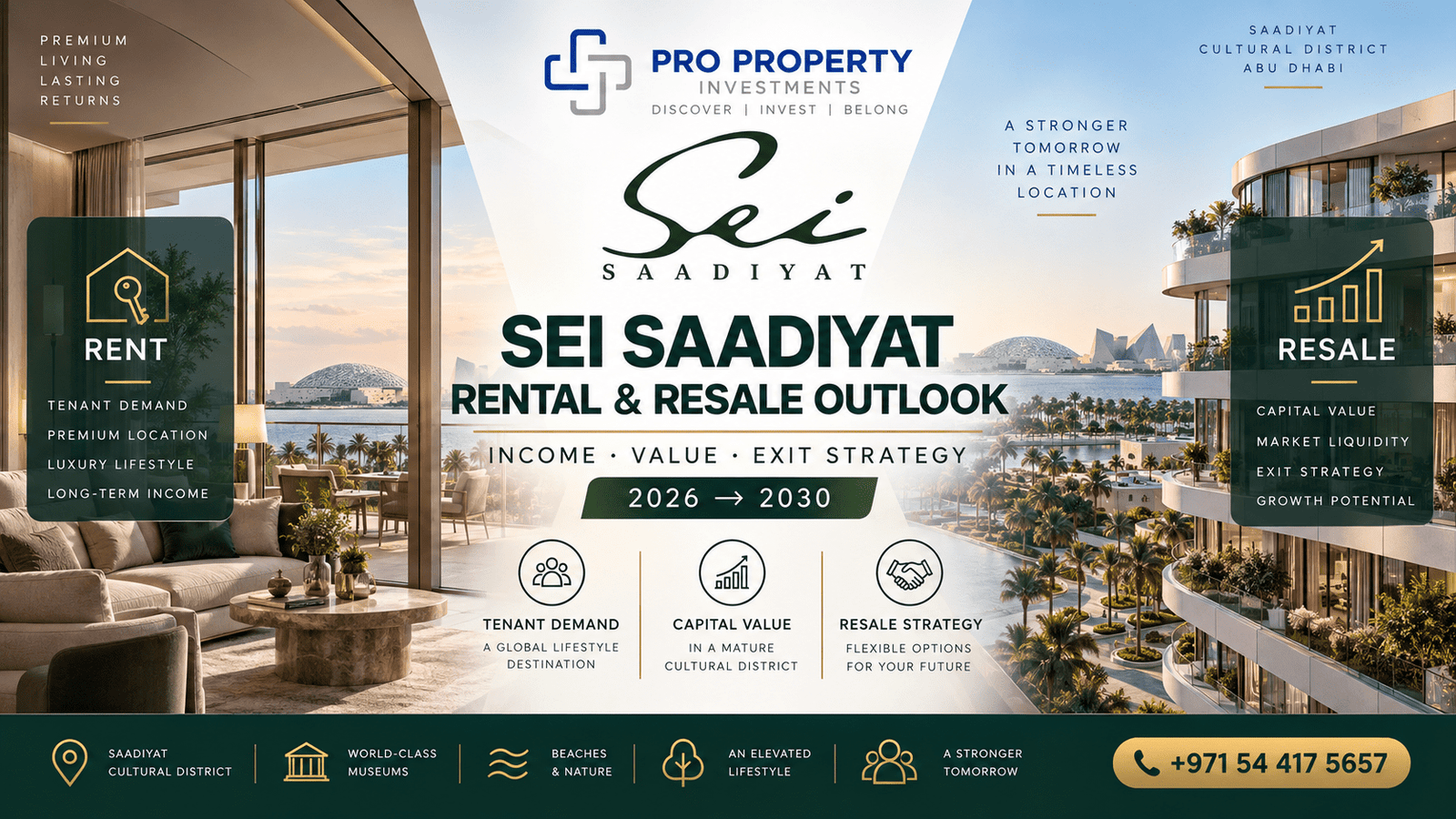
Does Sei Saadiyat make more sense as a rental-income investment or as a long-term capital asset?
These questions are particularly relevant for Sei Saadiyat by Aldar, because buyers entering the project in 2026 are acquiring an off-plan residence scheduled for estimated completion in Q4 2030.
Aldar currently lists 778 residences across six residential towers, including 1 and 2-bedroom apartments, 2-bedroom Kanso Lofts and 3-bedroom Kanso Residences. Prices start from AED 2.95 million, with a 50/50 payment plan and 5% down payment.
That means there is approximately a four-year gap between launch and expected handover.
For an investor, this creates two separate return periods.
The first is the construction period, during which there is no conventional rental income but the property's market value may rise, fall or remain broadly unchanged.
The second begins after handover, when the owner can potentially lease the residence, occupy it or sell into the completed-property market.
Understanding this distinction is essential.
Quick answer: Sei Saadiyat has credible long-term rental and resale demand drivers because it combines Aldar development, Saadiyat Cultural District positioning and a premium residential product. Current H1 2026 market data shows Saadiyat remains Abu Dhabi's most premium apartment location, while luxury rental demand remains substantial. However, Sei Saadiyat will not complete until Q4 2030, so today's Saadiyat rents or yields should not be presented as guaranteed future Sei Saadiyat returns.
Sei Saadiyat Investment Outlook at a Glance
| Factor | Current Position |
|---|---|
| Developer | Aldar |
| Location | Saadiyat Cultural District |
| Starting Price | AED 2.95M |
| Payment Plan | 50/50 |
| Initial Payment | 5% |
| Expected Handover | Q4 2030 |
| Total Homes | 778 |
| Current Saadiyat Apartment Rental Position | Ultra-luxury market |
| Current Saadiyat Avg. Apartment Rent | AED 191,000 |
| Current 1BR Avg. Asking Rent | AED 133,000 |
| Current 2BR Avg. Asking Rent | AED 252,000 |
| Current 3BR Avg. Asking Rent | AED 282,000 |
| Current Saadiyat Apartment Projected ROI | 3.51% |
| Saadiyat H1 2026 Residential Sales | AED 13.3B |
| Key 2030 Risk | Additional premium residential supply |
Current rental figures above come from Bayut's H1 2026 Saadiyat Island market analysis and represent the existing island market, not projected Sei Saadiyat rents.
That distinction should remain visible throughout this article.
Why Rental Forecasting for Sei Saadiyat Requires Discipline
There is a common problem in off-plan property marketing.
A project launches in 2026.
It will complete in 2030.
A brokerage looks at today's rents, applies them directly to the future apartment and announces:
“Expected ROI: 8%.”
That is not serious investment analysis.
Four years can materially change a residential market.
By 2030:
new buildings will have completed;
rents may be higher or lower;
interest rates may have changed;
service charges will be known;
different tenant groups may dominate the premium market;
new competing projects will exist;
and Saadiyat Cultural District itself will be substantially more mature.
Therefore, PPI should make a clear distinction between:
current market evidence
and
future investment scenarios.
This is actually better for SEO and AI search because it makes the article a reliable source rather than another sales page repeating unsupported return claims.
What Does the Saadiyat Rental Market Look Like Today?
The current rental market provides useful context.
Bayut's H1 2026 rental report identifies Saadiyat Island as Abu Dhabi's leading ultra-luxury apartment rental destination.
Its reported average apartment asking rent is approximately:
AED 191,000 per year.
By bedroom type, Bayut reports approximately:
| Apartment | Average Annual Asking Rent |
|---|---|
| 1 Bedroom | AED 133,000 |
| 2 Bedroom | AED 252,000 |
| 3 Bedroom | AED 282,000 |
Again, these figures should not be inserted into a Sei Saadiyat spreadsheet and presented as a 2030 forecast.
But they establish something important:
There is already a substantial premium rental market on Saadiyat Island.
Sei Saadiyat does not need to create luxury tenant demand from nothing.
Saadiyat Rental Rates Have Also Strengthened Over Time
Bayut's rental index shows current Saadiyat residential asking rent at around AED 122 per sq ft, representing approximately 17.19% growth over the previous 12 months in the index data available through July 2026.
By apartment type, the index currently shows approximately:
AED 126/sq ft for 1-bedroom apartments
AED 125/sq ft for 2-bedroom apartments
AED 109/sq ft for 3-bedroom apartments.
These figures illustrate an important feature of premium rental markets.
Larger properties do not necessarily produce higher rent per square foot even if they generate higher absolute annual rent.
That matters for Sei Saadiyat because a Kanso Residence may produce much more annual rent than a one-bedroom apartment but still deliver a different percentage yield relative to its acquisition cost.
Abu Dhabi's Wider Rental Market Is Strong
The broader Abu Dhabi rental environment also provides supportive evidence.
ADREC recorded approximately 233,000 active residential lease contracts worth AED 9.3 billion in H1 2026.
New-lease prices rose approximately 17% for apartments across Abu Dhabi, while apartment new-lease pricing within investment zones rose approximately 21%.
This is useful context for Sei Saadiyat.
The project is not launching into a weak rental environment where tenant demand is disappearing.
Abu Dhabi's investment areas are currently experiencing strong leasing activity and rising new-lease pricing.
But investors should remember:
2026 strength is evidence, not a 2030 guarantee.
What Is the Current Rental Yield on Saadiyat Island?
Bayut's H1 2026 sales analysis gives Saadiyat Island apartments a projected ROI of approximately 3.51%.
This is a particularly useful number because it helps correct a common misconception.
Premium real estate does not always produce the highest rental yield.
In Bayut's same H1 2026 analysis:
Saadiyat Island apartments were shown around 3.51% projected ROI;
The Marina around 5.40%;
luxury apartment areas such as Yas Island / Al Maryah around 5.94%;
while some affordable communities produced substantially higher percentage returns.
That is normal.
Lower-priced property can often generate stronger percentage yield because rent does not fall proportionately with purchase price.
Premium property competes on a different investment proposition.
Sei Saadiyat Is Probably Not a “Maximum Yield” Investment
This is one of the most important conclusions for potential buyers.
Someone whose sole objective is:
“I want the highest percentage rental yield in Abu Dhabi”
may find stronger opportunities elsewhere.
Saadiyat property carries a substantial location premium.
Part of the purchase price pays for:
cultural district positioning;
premium architecture;
island lifestyle;
developer quality;
scarcity;
views;
international buyer appeal;
and long-term destination value.
Those features can strengthen rental demand.
But they also increase acquisition cost.
As a result, the rental-income percentage may be lower than in more affordable districts.
That does not make the property a bad investment.
It makes it a different type of investment.
The Sei Saadiyat Return Thesis Is Likely to Have Two Components
For a successful long-term investor, overall property performance may come from:
1. Rental income
plus
2. Capital appreciation.
A lower-yielding premium property can still produce a strong total return if the asset appreciates materially over time.
Conversely, a high-yield property can underperform if its capital value stagnates or declines.
Therefore, evaluating Sei Saadiyat solely through gross rental yield would ignore a major part of the potential investment case.
Current Saadiyat Capital-Value Performance Is Strong
Knight Frank reported in July 2026 that Al Saadiyat Island remained Abu Dhabi's most premium apartment location, with average transaction prices around:
AED 43,100 per square metre
as of June 2026.
That represented approximately 21% year-on-year growth in its analysis.
At the wider emirate level, ADREC reported that repeat-sale prices for apartments rose approximately 20% year-on-year during H1 2026.
Again, these historical growth figures should not be projected automatically forward.
A property that rose 21% in one period does not therefore rise 21% every year.
But the data demonstrates that Saadiyat entered the Sei launch period from a position of considerable market strength.
Saadiyat Also Has Deep Transaction Activity
Price appreciation means much less if very few properties trade.
Liquidity matters.
ADREC reported approximately:
AED 13.3 billion
in residential sales on Saadiyat Island during H1 2026.
That made Saadiyat one of Abu Dhabi's highest-value residential transaction districts during the period.
For future Sei Saadiyat resale potential, this is important.
It demonstrates that buyers are already willing to deploy significant capital into Saadiyat residential property.
A future Sei owner would therefore be selling into an established luxury-island market rather than attempting to create a new destination narrative.
The Off-Plan Market Is Also Highly Liquid Today
ADREC recorded AED 70.4 billion of residential unit sales during H1 2026, compared with AED 25.3 billion during H1 2025.
Off-plan transactions accounted for approximately:
89% of residential sales value
and
82% of residential deals.
This helps explain why newly launched projects such as Sei Saadiyat can generate substantial investor attention.
Buyers in Abu Dhabi are currently comfortable committing capital to future properties.
However, investors should not assume off-plan dominance will remain at exactly the same level throughout the four-year Sei construction cycle.
Market conditions evolve.
Could Sei Saadiyat Appreciate Before Handover?
Yes.
But it could also remain broadly flat or even experience periods of weaker resale pricing.
There are several potential drivers of pre-handover appreciation.
Later Sei phases may launch at higher prices.
The wider Saadiyat market may continue strengthening.
Cultural District infrastructure may become increasingly complete.
Premium Abu Dhabi property demand may continue expanding.
International capital may continue flowing into investment zones.
And specific highly desirable unit types may become scarce.
However, none of these outcomes are guaranteed.
If later supply increases rapidly or market sentiment weakens, appreciation could be limited.
The investor should therefore buy a property they can comfortably complete rather than depend on selling before handover.
Later Project Phases Could Matter
Sei Saadiyat comprises 778 homes across six residential buildings, while the initial launch phase represents only part of the wider development.
This creates an interesting future pricing dynamic.
If later buildings are launched at materially higher prices, early buyers may benefit because the developer itself establishes a new benchmark.
For example, someone purchasing at AED X per square foot in the first release may find that comparable future developer inventory is introduced at AED X plus a premium.
This can support secondary pricing.
But the reverse should also be acknowledged.
If market conditions weaken and later launches require incentives, payment-plan improvements or softer pricing, early purchasers may face competition.
Later-phase pricing is therefore an important variable to watch.
Which Sei Saadiyat Units May Have the Strongest Rental Demand?
The answer differs from the question:
Which unit may appreciate the most?
Rental tenants and resale buyers do not always prioritise the same things.
1-Bedroom Apartments
One-bedroom residences may appeal to executives, professional couples and international residents seeking a premium Saadiyat lifestyle without family-scale accommodation.
Their smaller total size can also keep annual rent below larger units, expanding the potential tenant pool.
For an investor focused on occupancy and liquidity, the 1-bedroom category deserves consideration.
2-Bedroom Apartments
Two-bedroom apartments may have the broadest tenant base.
Potential occupants include couples, small families, professionals wanting a home office and residents requiring guest accommodation.
Current Bayut rental data already shows particularly strong Saadiyat demand for larger apartment configurations: its H1 report notes that two-bedroom rental performance remained particularly strong within the island's premium segment.
This makes the 2-bedroom category interesting from a rental perspective.
2-Bedroom + Maid
The maid's-room configuration may be especially attractive to longer-term tenants and small families.
It adds household functionality without requiring a move into the much higher-priced Kanso range.
For a tenant planning to remain several years, practical space can matter more than architectural drama.
That can improve tenant retention.
A stable tenant who renews repeatedly can be financially valuable even if a more visually dramatic unit might theoretically command a higher headline rent.
Kanso Lofts: Premium Tenant or Smaller Audience?
The Kanso Loft could become one of the most interesting rental products in the development.
Its double-height living environment, internal staircase and architectural character distinguish it from conventional apartments.
That may allow the owner to target affluent executives, design-conscious tenants, international professionals or residents looking for a distinctive luxury home.
But there is a counterargument.
The unusual format may appeal to a smaller tenant audience.
Some families may prefer single-level accommodation.
Some tenants may prioritise an additional bedroom or maid's room over double-height volume.
Therefore, the Kanso Loft's rental thesis is likely to depend on premium positioning rather than mass demand.
3-Bedroom Kanso Residences
Three-bedroom Kanso Residences may appeal most strongly to affluent families and long-term residents.
This could be particularly important because larger premium Saadiyat rental inventory is inherently more expensive and therefore competes for a narrower tenant group.
But those tenants can also be more stable.
Families often care about:
space;
privacy;
work/study rooms;
maid accommodation;
parking;
community;
and long-term lifestyle.
A well-designed family residence can therefore support longer tenancy periods than an investment-heavy small apartment market.
Rental Yield vs Tenant Quality
Investors sometimes focus so heavily on yield that they ignore the quality of the underlying tenancy.
Imagine two properties.
Property A produces a slightly higher gross yield but experiences frequent tenant changes, vacancy periods and maintenance demands.
Property B produces a slightly lower headline yield but attracts a stable high-income tenant who remains for several years.
The difference in realised returns may be smaller than the initial spreadsheet suggests.
In premium real estate, tenant profile and retention can matter.
Sei Saadiyat's Cultural District location and higher acquisition prices suggest its rental market will likely depend more heavily on affluent professionals and families than on volume-driven rental demand.
What About Service Charges?
This remains one of the major unknowns for future net yield.
Sei Saadiyat is amenity intensive.
Its residential concept includes substantial landscaped spaces, wellness infrastructure and shared facilities.
Those amenities may improve rental appeal.
They will also require management and maintenance.
Therefore, future investors should calculate:
Gross rental yield
and
Net rental yield.
Gross yield ignores many ownership costs.
Net yield should consider service charges, management, maintenance, vacancy and other applicable expenses.
Until final service-charge information becomes available, any precise future net-yield projection would be speculative.
The 2030 Supply Pipeline Is the Largest Structural Risk
This is the counterweight to the bullish investment case.
ADREC currently projects approximately:
71,000 additional residential units
across Abu Dhabi by 2030.
Six districts—including Saadiyat Island—are expected to account for around 77% of that incremental supply.
This means Sei Saadiyat will not hand over into a market frozen in 2026.
It will enter a market containing much more residential stock.
Some of that stock will directly compete for premium tenants and buyers.
This is why investors should distinguish between:
Saadiyat scarcity
and
absolute absence of new supply.
Saadiyat remains a premium location.
But additional residences are coming.
How Can a Sei Saadiyat Unit Defend Itself Against Future Supply?
Through differentiation.
When more properties become available, interchangeable homes compete primarily on price.
Distinctive homes compete on features.
A Sei residence may therefore become more defensible if it has:
an exceptional permanent or difficult-to-obstruct view;
particularly efficient layout;
corner position;
higher floor with meaningful outlook;
Kanso architecture;
larger family format;
rare terrace;
strong privacy;
or another attribute that future supply cannot easily duplicate.
This is why unit selection matters so much.
A strong project does not make every unit equally strong.
Rental Strategy Option 1: Long-Term Leasing
The most conventional strategy after completion is annual residential leasing.
Advantages include relatively predictable occupancy, less frequent turnover and reduced operational complexity compared with short-stay hospitality.
This may suit investors who want relatively passive property income.
For large family residences, long-term leasing may be particularly logical because families generally want stability rather than frequent relocation.
Actual tenancy rules and building policies applicable in 2030 should be checked when the property completes.
Rental Strategy Option 2: Furnished Premium Leasing
A furnished strategy could suit certain Sei Saadiyat units, particularly smaller apartments or Kanso Lofts.
Premium international professionals, executives and relocating residents sometimes prefer homes that are ready for immediate occupation.
But furnishing is an investment.
Cheap furniture inside a premium property can actually undermine its positioning.
A furnished Sei residence would need a design standard consistent with the property itself.
Investors should therefore calculate:
furniture cost;
replacement cycle;
maintenance;
and potential rent premium.
The strategy only works if the higher rent justifies those additional costs.
What About Short-Term Rentals?
This should not be assumed today.
By the time Sei Saadiyat hands over, owners would need to consider the building's rules and whatever Abu Dhabi licensing and regulatory requirements apply at that time.
Even where short-term leasing is legally possible, it changes the nature of the investment.
Higher gross income can be accompanied by:
higher management fees;
greater furnishing expense;
cleaning costs;
higher wear;
vacancy variability;
and more active operational management.
Therefore, an investor should not buy Sei solely on a speculative short-term rental calculation four years before completion.
The Resale Question: Who Buys From You?
Every investor should ask this before purchasing.
You eventually need someone else to want the property.
The future Sei Saadiyat buyer could be:
another investor;
a UAE resident;
an international buyer;
a relocating professional;
a family;
a second-home buyer;
or an owner occupier seeking Cultural District living.
The broader the future buyer audience, the stronger the resale proposition.
This is one reason practical 1 and 2-bedroom units can perform well.
But it is also why rare premium properties such as Kanso Lofts can work—provided enough buyers value the distinctive architecture.
Resale Before Handover
A buyer may want to sell during construction.
Whether and when this is possible depends on the SPA, developer requirements, amounts already paid and applicable transaction rules.
Investors should therefore verify assignment conditions at purchase rather than assume unlimited resale flexibility.
More importantly, a profitable pre-handover sale requires market demand at a price above your effective cost.
Marketing phrases such as:
“flip before completion”
make the strategy sound automatic.
It is not.
Pre-handover resale is an exit option, not a guaranteed return mechanism.
Resale at Handover
Handover can create an important liquidity event.
Why?
Because the property changes from:
future promise
to
physical asset.
Buyers can inspect the building.
Views become real.
Amenities operate.
Interior quality can be judged.
Rental evidence begins developing.
Mortgageability may broaden.
And owner occupiers can move in.
A project that delivers particularly well can therefore attract a new category of buyers who were unwilling to purchase off-plan.
That can potentially strengthen resale demand.
But Handover Can Also Bring Competing Sellers
There is another side.
Some investors buy specifically to sell at completion.
If many owners adopt the same strategy, a large number of similar properties can reach the market at once.
That creates competition.
A seller with a weak unit may need to reduce price to attract attention.
This is another reason to buy a residence with something defensible.
When twenty similar apartments are listed, buyers ask:
Which one gives me the most for my money?
A premium view or better layout can answer that question.
Resale After the Community Stabilises
An alternative strategy is to hold beyond handover.
This allows the development to establish:
rental history;
service-charge history;
building reputation;
community occupancy;
resale comparables;
and a functioning lifestyle ecosystem.
Some premium developments become more attractive once landscaping matures and buyers can experience the community as intended.
That can create a different resale environment from the hectic period around initial handover.
For long-term investors, this may be the more natural strategy.
A Potential Sei Saadiyat Exit Strategy Framework
Instead of deciding today:
“I will definitely sell in 2030,”
a buyer can create multiple exit scenarios.
Scenario A — Sell during construction
Consider only if market pricing creates an attractive premium and the SPA permits transfer on acceptable terms.
Scenario B — Sell at handover
Useful if completed-product demand is strong and the owner prefers not to become a landlord.
Scenario C — Lease after handover
Generate rental income and reassess market value after several years.
Scenario D — Hold long term
Use Sei as a premium capital asset and participate in the continued maturation of Saadiyat.
This optionality is valuable.
The investor does not need to know the exact 2030 decision in 2026.
They need enough financial strength to avoid being forced into one.
Forced Selling Is the Real Risk
The worst time to sell a property is often when you have to sell.
A buyer who can only complete the Sei purchase by immediately finding another purchaser near handover carries significant risk.
If the market is strong, the strategy may work.
If the market softens, there is little flexibility.
By contrast, an investor capable of paying the handover balance can choose:
sell;
rent;
occupy;
or hold.
Financial capacity therefore creates strategic optionality.
That may be more valuable than trying to predict exact 2030 pricing.
How International Demand Could Support Resale
ADREC reports that resident expatriates and non-resident foreign buyers collectively represented approximately 70% of residential sales value in H1 2026.
This matters significantly for premium investment areas.
A future Sei seller is not necessarily dependent on a purely local buyer base.
Saadiyat's cultural identity is also highly legible internationally.
A buyer unfamiliar with every Abu Dhabi community may still understand the significance of living near internationally recognised museums and cultural institutions.
That recognition can make the property easier to position globally.
Could Sei Saadiyat Outperform Older Saadiyat Buildings?
Possibly.
New buildings sometimes command premiums because they offer newer design, updated amenities and contemporary specifications.
But “new” is temporary.
By 2035, Sei will no longer be a new project.
Its long-term performance will depend on how well the property ages.
Key issues will include:
construction quality;
building management;
maintenance;
service charges;
amenity upkeep;
community reputation;
and how future Aldar projects compare.
A building that is beautifully maintained can remain premium for decades.
A poorly managed luxury building can lose its advantage surprisingly quickly.
Building Management Will Matter to Resale Value
Investors often spend months selecting the property and almost no time thinking about the community after handover.
Yet management quality can materially influence:
tenant satisfaction;
common-area appearance;
maintenance;
service charges;
amenity condition;
and ultimately resale reputation.
A luxury address needs luxury-level operational consistency.
The strongest architectural concept can lose value if lifts, landscaping, pools and shared spaces are poorly maintained.
For long-term Sei investors, management performance will become an important indicator after completion.
How Should Investors Think About Today's 3.51% Saadiyat ROI?
They should treat it as:
market context.
Not:
Sei Saadiyat forecast.
Bayut's current projected ROI of approximately 3.51% for Saadiyat Island apartments indicates that the island's investment proposition is not primarily based on generating the emirate's highest percentage rental returns.
That aligns with Saadiyat's premium positioning.
Someone buying Sei should therefore be comfortable with the possibility that the property's total investment thesis relies meaningfully on long-term capital value rather than rental yield alone.
What Rental Yield Would Make Sei Attractive?
There is no universal answer because investors have different capital costs and objectives.
A cash buyer may accept a lower yield for a scarce premium asset.
A leveraged buyer has financing costs to consider.
An investor comparing Sei with bonds, equities or other property markets may require a different minimum return.
The correct question is therefore:
What net return do I require relative to the risk and capital committed?
That calculation should be made after service charges, management and realistic vacancy assumptions—not simply headline rent divided by purchase price.
Is Sei Better for Capital Appreciation Than Rental Yield?
Based on the project's positioning, the investment case appears more naturally aligned with a blended capital-growth and premium-rental strategy than with maximum income yield.
Why?
The acquisition price is premium.
The location is scarce.
The project is design-led.
Saadiyat already trades at the upper end of Abu Dhabi apartment pricing.
And existing market data shows Saadiyat yields are more moderate than several lower-priced investment districts.
That profile typically attracts investors who value asset quality and long-term capital positioning as much as immediate income.
Which Sei Unit May Be Best for Resale?
Different units have different advantages.
One Bedroom
Broadest affordability within the development.
Potentially easier resale ticket.
Standard Two Bedroom
Broad buyer and tenant audience.
Strong balance between usability and total capital.
2BR + Maid
Practical end-user appeal and larger usable area.
Potentially attractive for small families.
Kanso Loft
Strongest architectural differentiation and scarcity.
But higher price and narrower audience.
3BR Kanso Residence
Premium family/end-user product.
High absolute ticket but potentially strong long-term owner-occupier appeal.
There is no universally best option.
The Best Rental Unit May Not Be the Best Resale Unit
This is important.
A conventional 2-bedroom could potentially have excellent rental liquidity because many households understand and need that format.
A Kanso Loft could potentially produce stronger resale scarcity because fewer comparable properties exist.
The two investment objectives do not necessarily point to the same residence.
Buyers should therefore decide which matters more:
income consistency
or
asset differentiation.
What Could Hurt Sei Saadiyat Rental Demand?
Several risks deserve acknowledgement.
A large increase in premium competing supply could give tenants more negotiating power.
High service charges could push landlords to demand rents the market does not support.
A slowdown in Abu Dhabi's high-income employment market could weaken luxury tenant demand.
Alternative premium communities could offer better value.
And poorly differentiated Sei units could compete against each other.
These are real investment risks.
Ignoring them does not make an investment analysis stronger.
What Could Strengthen Rental Demand?
The opposite scenario is also credible.
Demand could be supported by continued population growth, international investment, the maturation of Saadiyat Cultural District, Abu Dhabi's expanding cultural and tourism economy, premium employment growth and scarcity of genuinely high-quality residences.
Current market data already shows strong new-lease growth within Abu Dhabi investment zones.
By 2030, the Cultural District will also be materially more established than at the time of Sei's 2026 launch.
This creates a plausible rental-demand thesis.
It should simply not be converted into guaranteed percentages today.
What Could Hurt Sei Resale Values?
Future resale could be pressured by:
large competing supply;
economic slowdown;
higher financing costs;
later Aldar launches offering better pricing;
poor building management;
unexpectedly high service charges;
or owners listing too many similar units simultaneously.
The property's purchase price also matters enormously.
Even an excellent asset can produce a weak return if bought at an excessive premium.
What Could Strengthen Resale Values?
Potential positive drivers include:
continued Saadiyat appreciation;
higher pricing in future Sei releases;
strong finished construction quality;
permanently attractive Cultural District views;
successful Kanso product differentiation;
continued foreign investment;
and a high-quality community reputation after completion.
These are the factors investors should monitor between now and 2030.
Key Indicators to Watch Every Year
PPI should actually update this article annually rather than publish it once and forget it.
The most important indicators are:
Saadiyat apartment price per square foot;
Saadiyat average rents;
Saadiyat transaction volume;
later Sei launch pricing;
construction progress;
new competing Saadiyat supply;
service-charge guidance;
foreign-buyer activity;
and Abu Dhabi investment-zone rental growth.
That turns the article into a living investment resource.
It is also excellent for SEO because the URL can accumulate authority while the data remains current.
Frequently Asked Questions
Can I rent out Sei Saadiyat after handover?
The development is residential property and investors can evaluate conventional leasing after completion subject to applicable laws, building rules and transaction requirements in force at the time.
When will Sei Saadiyat start generating rent?
Conventional rental income would ordinarily only begin after completion and handover. Aldar currently estimates Q4 2030.
What is the current average rent on Saadiyat Island?
Bayut's H1 2026 rental report shows an average apartment asking rent around AED 191,000 per year across Saadiyat Island.
What is the current rent for a 1-bedroom Saadiyat apartment?
Bayut reports an average around AED 133,000 annually for 1-bedroom apartments in its H1 2026 analysis.
What is the current rent for a 2-bedroom?
Bayut reports approximately AED 252,000 annually for 2-bedroom apartments in its H1 2026 data.
What is the current rent for a 3-bedroom?
The same report gives approximately AED 282,000 annually for Saadiyat 3-bedroom apartments.
What rental yield does Saadiyat currently offer?
Bayut's H1 2026 sales-market analysis gives Saadiyat Island apartments a projected ROI around 3.51%. This is an island-wide market figure, not a future Sei Saadiyat forecast.
Will Sei Saadiyat have the same rental yield?
Not necessarily. Sei will complete around 2030, when rents, prices, service charges and competing supply may all differ from today's market.
Is Saadiyat good for capital appreciation?
Recent market performance has been strong. Knight Frank reports Saadiyat apartment prices around AED 43,100 per sqm in June 2026, approximately 21% higher year-on-year. Past performance does not guarantee future appreciation.
How active is the Saadiyat sales market?
ADREC recorded approximately AED 13.3 billion in Saadiyat residential sales during H1 2026.
Can I sell Sei Saadiyat before completion?
Potential assignment or resale depends on the SPA, developer requirements, payment status and applicable transaction rules. Buyers should verify the specific conditions before purchase.
Is it better to sell before or after handover?
There is no universal answer. Before-handover resale may capture early appreciation if the market is strong, while post-handover resale gives buyers a physical asset and established rental evidence.
Which Sei unit might rent best?
Standard 1 and 2-bedroom apartments may appeal to broad tenant groups, while larger and Kanso residences target more specialised premium tenants.
Is Sei Saadiyat better for income or long-term appreciation?
Based on current Saadiyat market characteristics, it appears more naturally suited to a blended premium-rental and long-term capital-value strategy rather than a maximum-yield strategy.
Final Verdict: What Is the Rental & Resale Outlook for Sei Saadiyat?
Sei Saadiyat enters the market with several strong fundamentals.
Saadiyat Island is already Abu Dhabi's most premium apartment location according to Knight Frank.
It recorded AED 13.3 billion in residential sales during H1 2026.
Current rental-market data also shows substantial premium tenant demand, including average asking rents of approximately AED 133,000 for one-bedroom and AED 252,000 for two-bedroom Saadiyat apartments.
Those numbers provide a strong foundation.
But investors need to keep the timeline in perspective.
Sei Saadiyat is expected to complete in Q4 2030.
By then, Abu Dhabi will have substantially more housing supply, and Saadiyat itself is one of the districts expected to absorb a large portion of the emirate's new stock.
That means success will depend increasingly on unit quality and differentiation.
A buyer should not purchase simply because:
“Saadiyat always goes up.”
Nor should they expect today's rent to remain unchanged four years from now.
The stronger strategy is to buy an asset that remains attractive under multiple market conditions.
A residence with a strong floor plan.
A defensible view.
A rational acquisition price.
A buyer profile broader than one speculative investor group.
And enough quality to remain desirable even when more apartments arrive.
For the right buyer, Sei Saadiyat can potentially serve three functions:
a future income-producing residential asset,
a premium Abu Dhabi capital holding,
and
a property with multiple resale or occupancy options after 2030.
The best investment strategy is therefore not to predict the exact rent or sale price four years in advance.
It is to preserve options.
For current Sei Saadiyat inventory, unit comparisons and investment analysis, contact Pro Property Investments at +971 54 417 5657.
Join The Discussion